Why Vape Cartridges Clog (And What We Did to Stop It)
The Most Common Complaint Nobody Engineers Around
If you've ever bought a vape cartridge, there's a good chance the thing eventually clogged on you. You pull, nothing happens. You pull harder, still nothing. You take the cap off and let it sit. You blow back through it. You stick a paperclip in the mouthpiece. Maybe it comes back, maybe it doesn't.
It's the single most common complaint about cartridges. Walk into any dispensary in California and ask a budtender what people return carts for, and "it clogged" will be near the top of the list every time. And yet almost nobody in the industry talks about why it happens, or what you'd actually have to do to prevent it.
That's the part Nick (our chemical engineer and the reason most of these decisions get made the right way) finds genuinely weird. It's a solvable problem. The physics are well understood. The hardware exists. So here's the calculation almost every brand on a California dispensary shelf has silently made: clogs happen after the customer pays. The customer absorbs the loss. They buy another cart anyway. The brand keeps its margin. That math has been the standard build of the cartridge industry for almost a decade.
We made a different calculation, which is the whole reason this post exists. Here's what's actually happening inside a cartridge when it clogs, the choices a brand has to make to engineer against it, and a voicemail a customer named Dan left that suggests we got it mostly right.
What's Actually Happening When a Cart Clogs
A vape cartridge is basically a tiny fluid-dynamics problem. You have a viscous oil sitting in a tank. You have a heating element at the base that needs to draw a small amount of that oil up to a hot surface, vaporize it, and pull the vapor down through an airflow channel into your mouth. Every clog is a failure of one of those steps.
Viscosity. Cannabis oil is thick. Live resin and rosin are thicker still. The thicker the oil, the harder it is to move through the small channels inside a cartridge. At room temperature, a high-terpene live resin can have the viscosity of cold honey. The atomizer has to pull that oil into a wick or porous ceramic and get it to a vaporization surface fast enough to keep up with your inhale. If the oil doesn't move fast enough, you get a dry hit, the atomizer overheats, and the surrounding oil thickens further. That's the first stage of a clog.
Terpene-to-oil ratio. Terpenes are what give cannabis its smell and flavor, but they're also a solvent. Higher terpene content lowers viscosity, which is good for flow. But too high a terpene ratio and the oil starts behaving more like a liquid than a syrup, which causes the opposite problem (atomizer flooding, where oil pools at the heating element and gets pulled into the airflow path as liquid instead of vapor). You see this when a cart spits or you taste raw oil. So there's a real range you're targeting, and most brands either don't measure it or don't know what to do about it when they do.
Airflow path geometry. This is the part most people don't think about. The air you inhale has to travel from the intake holes at the base of the cart, past the heating element, up through the center post, and out through the mouthpiece. Every angle and diameter change in that path affects how the air pulls vapor. A poorly designed airflow channel creates pockets where vapor condenses back into oil on the inside walls. That condensed oil migrates downward, accumulates at the mouthpiece end, and at some point physically blocks the channel. That's the second stage of a clog, and it's almost entirely a hardware design problem.
Heat distribution. A ceramic atomizer that heats unevenly will char the oil in one spot and undervaporize it in another. The charred oil leaves a residue on the ceramic, which reduces its porosity, which means less oil can be drawn up per hit, which means the user pulls harder, which means more condensation in the airflow path. Once a cart starts down this path it usually doesn't come back.
Oil migration. When a cart sits idle (in a pocket, in a car, on a nightstand), oil slowly migrates around the inside of the cartridge by capillary action and gravity. If the airflow channel doesn't have a proper seal at the atomizer, oil migrates into the channel itself and pools at the mouthpiece. That's why so many people get a cart that "clogs overnight." It didn't really clog from heat or use. It clogged from sitting still.
So a clog isn't one thing. It's usually a chain reaction across several of these factors, and the cheaper the cartridge, the more of them are stacked against you.
What Most Brands Are Actually Using
Pick up a typical cartridge on a California dispensary shelf and you're looking at a cotton-wick atomizer (sometimes a low-grade ceramic), a single airflow hole at the base, no real engineering on the airflow geometry, and an oil that was formulated without any specific viscosity target beyond "fits in the cart." That's the standard build. It's been the standard build since 2017 or so. Most of the supply chain is set up to produce exactly this.
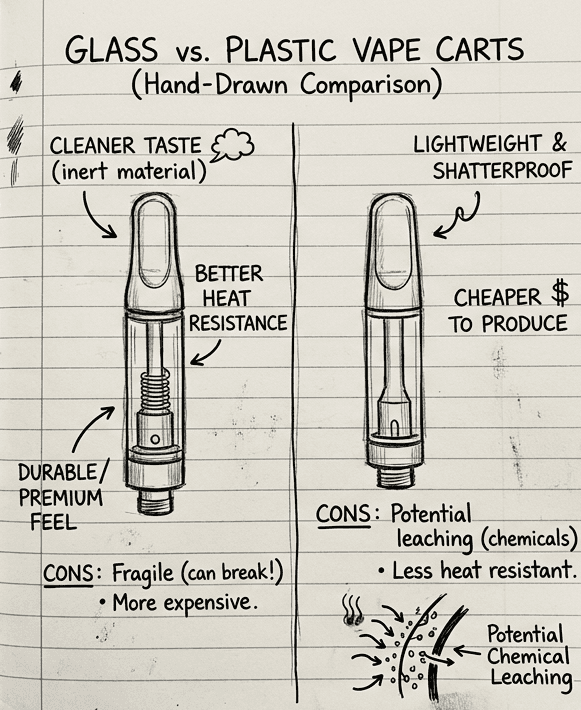
The reason is the same reason most carts are plastic instead of glass (a thing we wrote about separately so I won't rehash it here). It's cost. A cotton-wick atomizer costs cents. A properly engineered ceramic atomizer with even heat distribution and tight porosity tolerances costs many times that. A dual-airflow cartridge requires more precise molding and an additional intake port. Custom airflow geometry requires actual fluid-dynamics work upstream.
If you're a brand assembling carts from off-the-shelf hardware and selling them at a competitive price, every one of these upgrades comes out of your margin. So you don't make them. You let the customer absorb the cost in the form of clogged carts and assume they'll buy another one anyway.
The thing that gets me is that the industry has basically priced clogging in as a normal feature of the product. People expect their carts to clog. They've trained themselves to keep a paperclip handy. That's wild when you stop to think about it. We're selling people something that we know is going to fail and we've shrugged at the failure mode for almost a decade.
What We Did
A few specific things, and they all have to work together. None of them in isolation is enough.
Dual airflow. Our cartridges have two intake ports at the base instead of one. The reason isn't to give you a fatter hit (though it does that too). The reason is fluid dynamics. With a single intake, you create a strong directional pull that drags oil from the surrounding chamber toward the airflow path. That pull contributes to the condensation-and-migration problem I described above. Two intake ports distribute the airflow more evenly across the base of the atomizer, which produces a more laminar flow up through the center, which means less turbulence, which means less vapor condensing back into oil on the channel walls. The hit also feels smoother because the air isn't getting pulled through a single narrow opening. The two are connected.
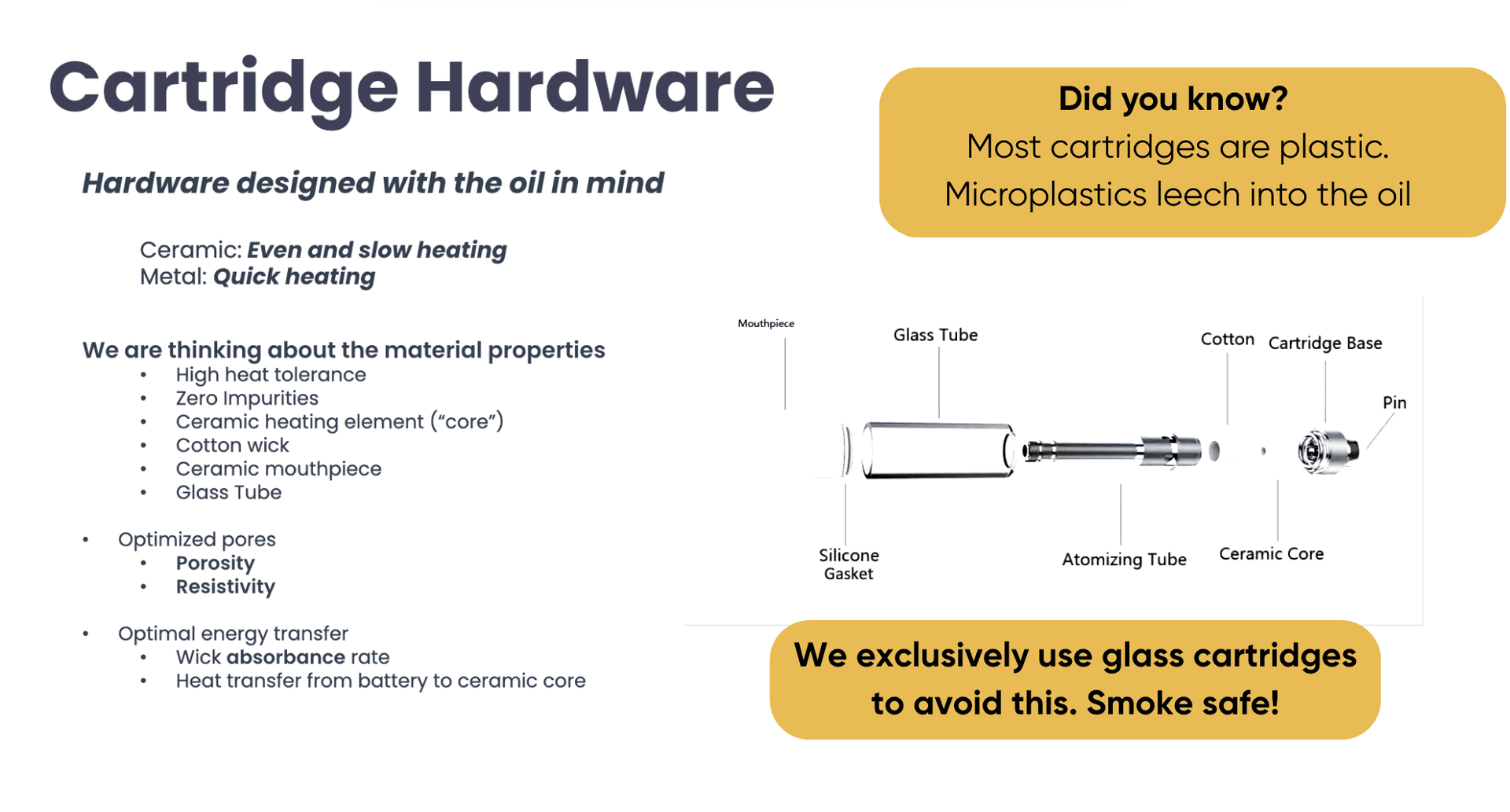
Ceramic atomizer with controlled porosity. Not all ceramic atomizers are the same. The cheap ones are basically a porous block of ceramic with a heating coil embedded in it, and the porosity varies wildly across the surface. Ours is sourced and spec'd specifically for porosity tolerance and heat distribution, not just whatever the off-the-shelf supplier had that week. That means the oil is drawn into the atomizer uniformly, gets heated to the same temperature everywhere, and vaporizes cleanly without charring in one spot and pooling in another. The atomizer stays clean longer, which means it draws oil at the rate it was designed for, hit after hit, for the entire cart.
Ceramic is also inert, which is why we use it everywhere instead of cotton wicks. The standard cartridge build uses cotton wicking to draw oil into the heating element. Cotton chars. Charred cotton tastes like burnt popcorn and it reduces oil flow over time. Ceramic doesn't have that failure mode. The image at the top of this post is the standard industry cartridge anatomy with the cotton wick called out. Ours subs in ceramic in that role, which is most of what this section is about.
Extraction-side viscosity targeting. This is the part that's invisible to the customer but matters as much as the hardware. Our oil is formulated to hit a specific viscosity range that matches what the atomizer was designed to pull. Nick can talk about this for an hour, but the short version is that our extraction process targets a terpene-to-cannabinoid ratio that produces oil thin enough to flow consistently into the atomizer but thick enough to not flood it, and we test the loaded cartridge under real-use conditions (sitting overnight, hot pocket, cold car, hard pulls back-to-back) before any of it ships.
That last part is the one most brands skip entirely. They formulate to a target THC percentage and call it done. And here's the part nobody in cannabis seems to want to say out loud: higher TAC actively trades against clog resistance. The more potent the oil, the thicker it is, and the harder it is to flow through the hardware. Brands chasing the TAC arms race are degrading the product's most basic function (working) in the name of a number that looks better on the shelf.
Potency is meaningless if the cart clogs in week two. Our high-THC line runs 90 to 94% TAC depending on the batch and the state listing, but only because the extraction process is tuned for the oil to actually move through the hardware it's going into.
No oil-path adhesives. This is more of a contamination thing than a clog thing, but it matters here too. A cartridge with adhesive in the oil path can get soft adhesive in the airflow channel when it heats up, which becomes a literal physical blockage. Ours uses press-fit assembly, so the only things touching the oil are glass, ceramic, and medical-grade stainless steel. There's nothing in the path that can degrade and obstruct flow.
Dan Called This Morning
This is one of those things you can't really plan for.
Nick's phone number is on the back of every Halara package. It's been there since the beginning. The idea was that if a customer ever has a problem, they should be able to talk to one of us. Most people don't call. Some do. Mostly it's for genuine product issues, which we want to hear about. Occasionally it's because someone wants to ask where their nearest dispensary is. Once it was a budtender at 11pm asking if we had any samples left for a staff training.
This morning Nick got a voicemail from a guy named Dan.
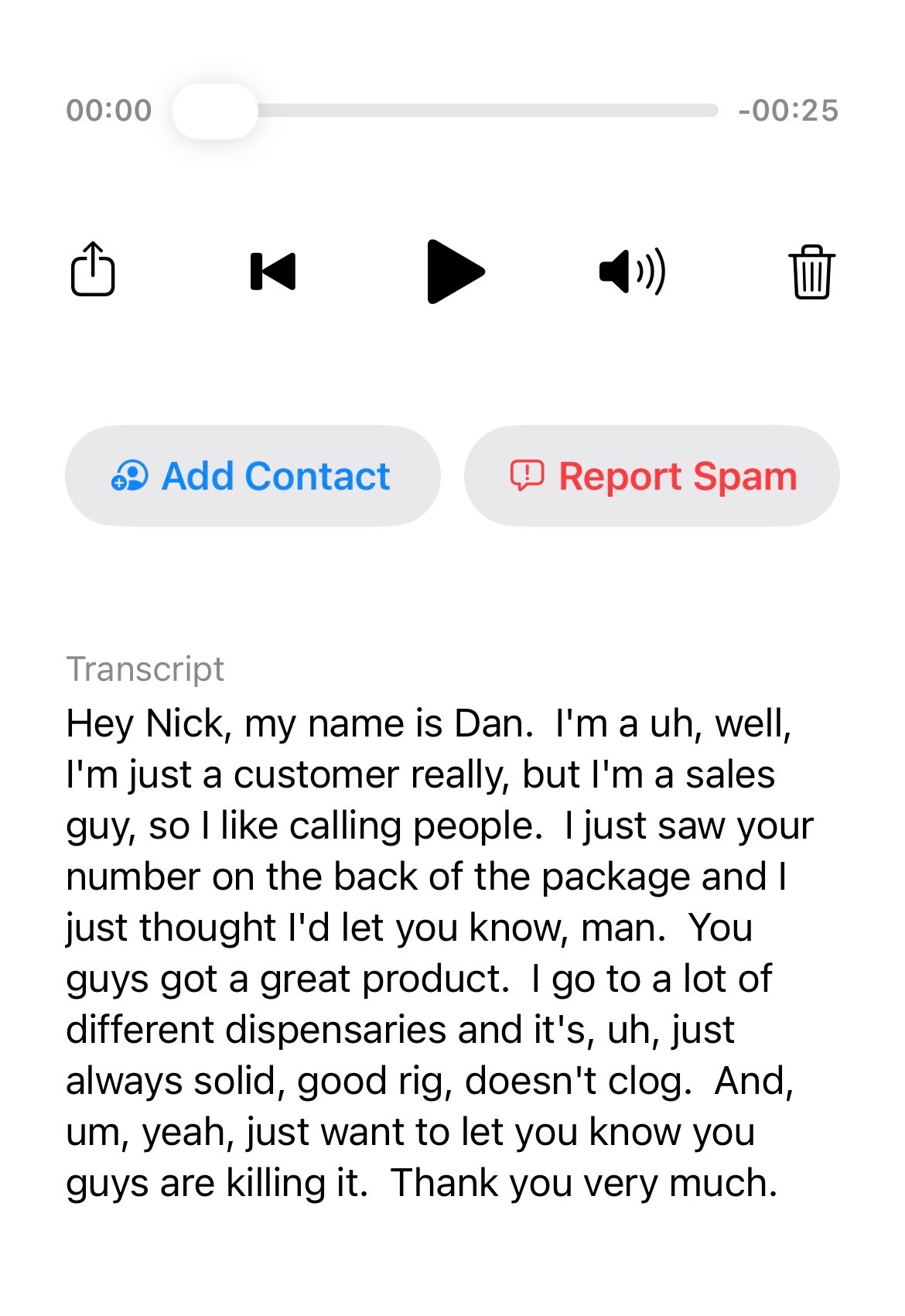
"Hey Nick, my name is Dan. I'm a uh, well, I'm just a customer really, but I'm a sales guy, so I like calling people. I just saw your number on the back of the package and I just thought I'd let you know, man. You guys got a great product. I go to a lot of different dispensaries and it's, uh, just always solid, good rig, doesn't clog. And, um, yeah, just want to let you know you guys are killing it. Thank you very much."
Dan is a sales guy, so he probably appreciates a good cold call more than most. But the line that mattered to me was "doesn't clog." That's the line you don't get from a customer unless the product is actually working, because clogging is the thing customers complain about. They don't usually go out of their way to compliment its absence. They just notice that the cart they bought from us keeps hitting the way it did on day one, and at some point they think to mention it.
Dan isn't a paid review. He's not someone we know. He just bought a cart, used it, noticed it kept working, and called the number on the bag. That's about as honest a signal as you get in this business, and it lines up with what budtenders have been telling our reps for two years now. The hardware doesn't clog. The engineering choices we made actually work in the wild.
Where Our Carts Can Still Clog
I want to be honest about this part because I'd rather you have working assumptions than overpromises.
Our hardware is engineered to prevent the common clog failure modes I described above. It is not magic. There are still ways to get a cart of ours to clog, and most of them come down to environment and storage.
Cold storage. If you leave any cart, ours included, in a cold car overnight, the oil thickens significantly. The first few pulls in the morning, the atomizer is trying to draw cold, syrupy oil through what is otherwise a normally functioning system. You can get a temporary clog feeling. Warming the cart in your hand for a minute usually fixes it. Storing it at room temperature prevents it.
Storing it upside down or sideways for long periods. Oil migration is real. If you leave a cart upside down for days, oil migrates into the airflow channel by gravity and capillary action, and you can end up with oil pooling in the mouthpiece. Store carts upright. The Halara AIO is designed so that the natural resting position keeps the oil away from the airflow path, but extended improper storage will defeat any cartridge.
Cap left off. If you lose the mouthpiece cap and leave the cart open in your pocket, dust and lint can collect in the mouthpiece airway and create a partial block. It's not the cart failing. It's environmental contamination.
Way past expiration. Cannabis oil oxidizes. After a year or so on a shelf, terpenes evaporate, the oil thickens, and viscosity drifts out of the range the hardware was designed for. We date everything for a reason.
If you do all of the above to a Halara cart at the same time, you can get it to clog. We've had it happen. The vast majority of our customers don't. Our internal return rate on clog issues sits under 0.1%, and the budtenders and buyers we work with tell us they see maybe one clog return in two years across our whole SKU set, if that. Which still isn't zero. Carts are physical objects and physics doesn't care that we're trying.
What This Means If You're Buying a Cart
Most of the post above is engineering detail, but the practical takeaways are pretty simple.
If you're at a dispensary and you're trying to figure out which AIO is least likely to clog on you, look for these things:
- Dual airflow at the base of the cartridge. You can see it. Look for two intake holes instead of one.
- Ceramic atomizer, not cotton wick. Most brands that use ceramic say so. If the brand doesn't mention what their atomizer is, it's probably a cotton wick.
- A real story about extraction and viscosity targeting. If the only thing the brand can tell you about their oil is "premium" and "clean" and "lab-tested," they probably haven't done the extraction-side work. Specifics beat adjectives, and we went and checked what California brands actually disclose about their own hardware if you want to see how thin that disclosure gets.
- Price as a signal. Anti-clog engineering costs more per unit. A $15 cartridge is almost certainly using the standard cheap-build hardware. Our AIO sits at $25 to $29 in most California dispensaries because that's what it costs to make the thing right.
The industry priced clogging in as a feature of the product. We chose to engineer it out, which costs us per-unit margin we don't get back. That's most of the reason our high-THC AIOs sit at $25 to $29 across 300+ California dispensaries and the cheap cart on the shelf next to ours costs $15. Dual airflow, ceramic atomizers, and extraction tuned to the hardware all show up in the price because the alternative is to show up in the customer's pocket two weeks later as a clogged piece of hardware they have to replace.
Dan figured it out and called to let us know. We appreciated it more than he probably realized.
If your current cart clogs, try one of ours. If it still clogs, call Nick. His number's on the bag.
Malcolm
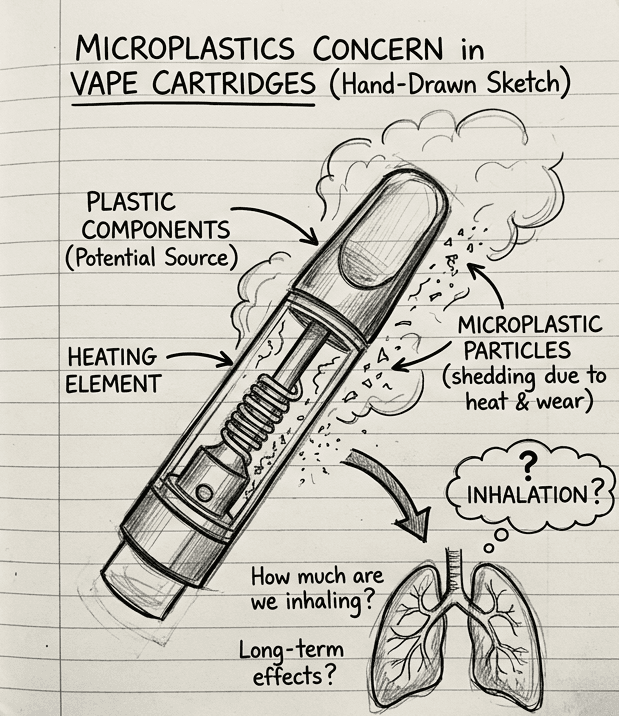
For more on the hardware side of this, our piece on glass vs. plastic vape cartridges covers the tank material question. For the cleaner-air version, microplastics in vape cartridges is the consumer-friendly checklist.
Want more cannabis intel?
Join The Dealers Diary — weekly strain spotlights, industry news, and insider access.
Subscribe Free