Why Vape Cartridges Have to Be Tested After They're Filled (Not Before)
A Recall Over Something Most People Never Think About
Last month, Missouri regulators pulled hundreds of cannabis vape cartridges off dispensary shelves. The reason wasn't pesticides. It wasn't mold or heavy metals or a potency number that didn't add up. It was a testing gap that almost no consumer has ever heard of, and one that turns out to matter more than it sounds like it should.
The manufacturer had tested its oil as a barrel of bulk concentrate, before any of it was loaded into a single cartridge. State rules require the opposite. You test the product in the form the customer actually buys it, which means you test the filled cartridge, not the oil that's going to go into it. The company argued the requirements were "evolving." Missouri regulators said nothing had changed, and that finished-product testing had been the rule since the state's recreational program started in 2023. The recall stood. You can read the full account at the Missouri Independent, and it's worth your time, because the boring procedural detail at the center of it is actually a real consumer-safety story.
Here's the version that matters to anyone who buys carts. The reason you test the finished cartridge and not just the oil is that the cartridge can change the oil. What's clean in a barrel is not guaranteed to be clean after it's sat inside a piece of hardware for a few weeks. That's the whole point, and it's the part the industry would mostly rather you didn't think too hard about.
What "Finished-Product Testing" Actually Means
When a brand makes a batch of vape oil, there are two moments it could hand a sample to a lab.
The first moment is right after extraction, when the oil is still a bulk concentrate sitting in a container. The second moment is after that oil has been filled into the actual cartridges, capped, and packaged the way it'll be sold. Those two samples can produce different lab results, and the difference between them is the entire reason finished-product testing exists.
Bulk-oil testing is faster and cheaper. You pull one sample from one barrel, you get one Certificate of Analysis, and you can stamp it across every cartridge that barrel fills. Finished-product testing means you have to test representative cartridges from the actual finished run, which costs more and takes longer. From a pure margin standpoint, you can see why a brand under cost pressure would prefer the barrel. The catch is that the barrel test answers a question nobody is actually asking. Nobody inhales out of a barrel. They inhale out of the cartridge, after it's been sitting in a pocket or a glovebox or on a nightstand for a month.
The Mechanism: How a Cartridge Changes the Oil Inside It
This is the part Nick, our chemical engineer, can talk about at length, because it's a materials problem before it's a regulatory one.
A vape cartridge is not a neutral container. It's a small assembly of materials, all of them in direct contact with a warm, solvent-rich oil, and several of them capable of giving something back to that oil over time. Cannabis oil is full of terpenes, and terpenes are solvents. They're good at pulling compounds out of whatever they touch. Leave that oil in contact with the wrong materials, add a little heat, add a few weeks of time, and the oil can pick up things that were never in the barrel.
There are three places it tends to come from.
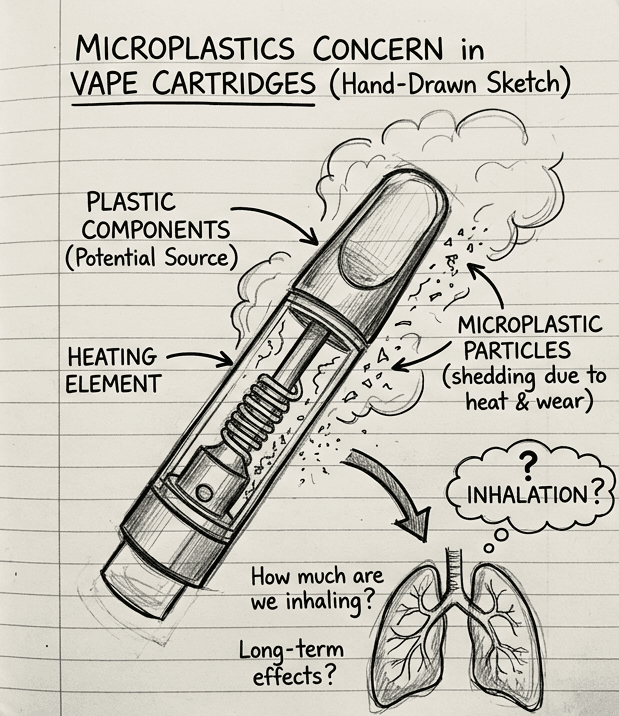
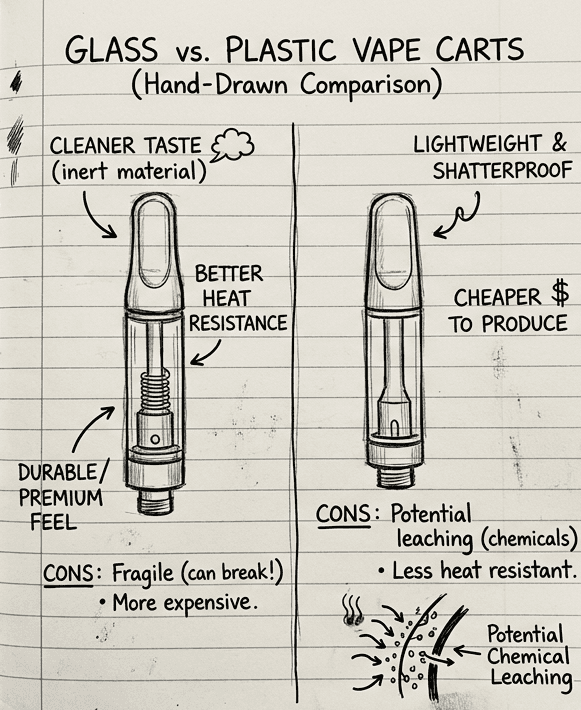
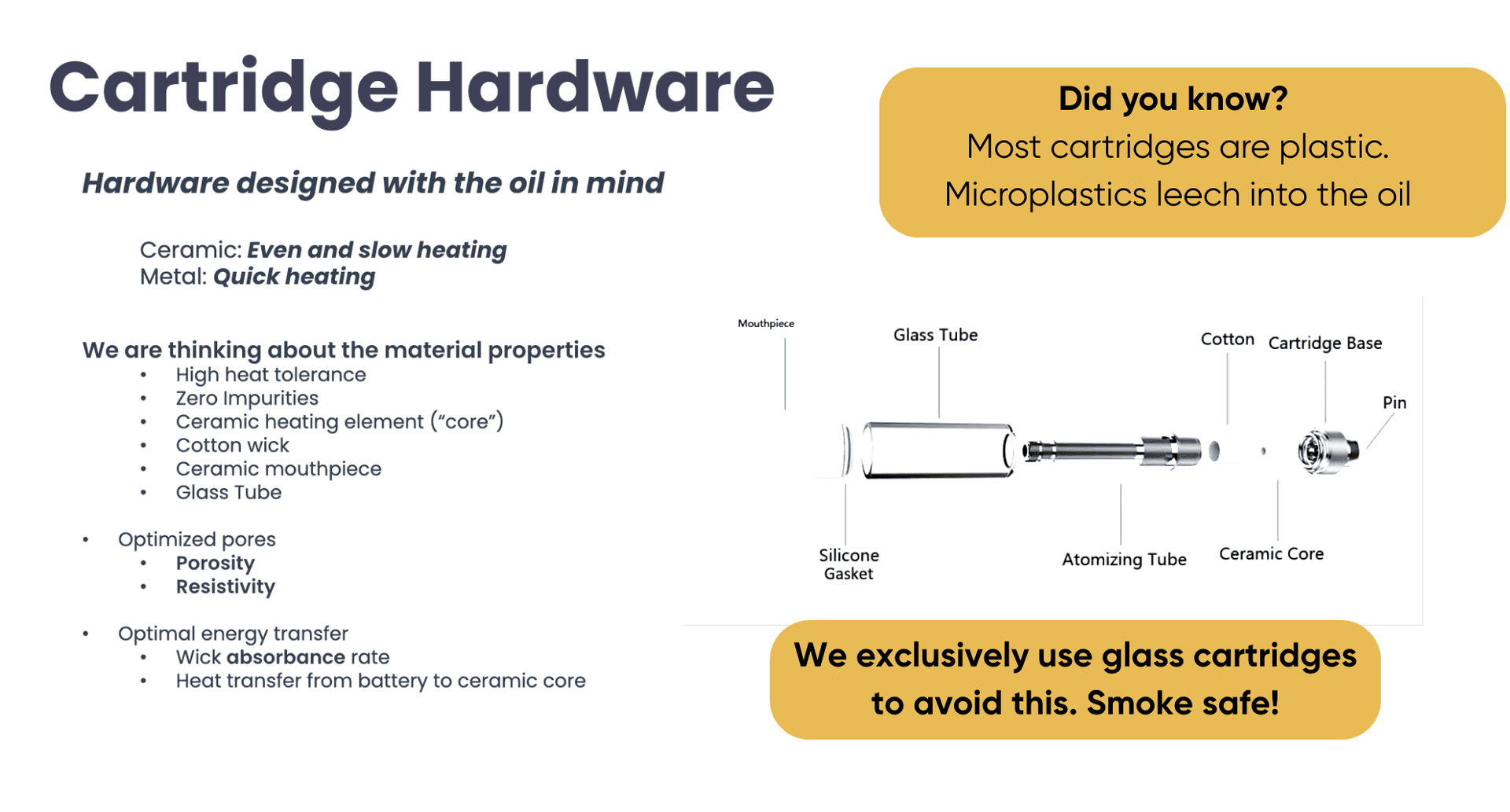
The tank. Most carts on the market use plastic tanks, not glass. When plastic is in long-term contact with a terpene-rich oil, and especially when it's heated on every pull, it can shed compounds into the oil. We went deep on this in our piece on microplastics in vape cartridges, including BPA and phthalates that can migrate out of plastic under heat. A barrel of oil tested before it ever met that plastic will look perfectly clean, because at that moment it was.
The heating element. Lower-quality metal coils can leach heavy metals like lead and nickel into the oil over repeated heating cycles. This is well documented in the e-cigarette literature, and it's a time-and-use phenomenon, not an instant one. A cartridge that passes a heavy-metals panel on day one can read differently after the coil has been cycled hundreds of times. Bulk oil never touches the coil at all, so a barrel test is structurally blind to it.
The adhesives and seals. Many cartridges glue the tank to the base assembly, and that adhesive sits in the oil's path. The glue gets warm on every hit. Whatever's in it has weeks to migrate. Most brands won't tell you what adhesive they use, which is its own answer.
None of this shows up in a barrel. All of it can show up in a finished, filled, aged cartridge. That's not a paperwork technicality. That's the gap between what got tested and what got inhaled.
Why the Barrel Test Survives Anyway
If finished-product testing catches more, why is bulk-oil testing still a thing brands reach for?
Because the incentives point the wrong way, the same way they do with clogging. A barrel test is one sample for a whole production run. A finished-product protocol means testing actual cartridges off the line, which is more samples, more lab fees, and more time before product can ship. When a brand is racing to get inventory onto shelves and margins are thin, the barrel is the tempting shortcut. And in a state where enforcement is loose or the rule is ambiguous, the shortcut mostly goes unnoticed, right up until it doesn't.
The Missouri case is interesting precisely because the rule there wasn't ambiguous. The state's lab-operations people were explicit that the finished-cartridge requirement exists specifically to catch leaching from the hardware, and that it had been in force for years. The dispute wasn't really about whether leaching is a concern. It was about whether a brand could test the cheaper way and call it compliant. The regulator said no.
What California Requires, and What We Do
California, like Missouri, requires that the regulated test be run on the finished product, not on pre-fill bulk oil. Every batch of legal cannabis in the state carries a Certificate of Analysis that's supposed to reflect the product as sold. That's the floor, not a favor, and it's one of the quieter inheritances of the way California built its testing regime around people who genuinely couldn't afford a contaminated batch.
Where a brand has room to do more than the floor is in the hardware itself, because the cleanest finished-product test is the one run on a cartridge that wasn't going to leach in the first place. We use glass tanks and ceramic heating elements, and we publish batch-specific COAs on the finished product for everything we sell. The point of the glass-and-ceramic build isn't a spec-sheet flex. It's that the materials touching the oil are the ones least likely to give anything back to it over the weeks a cartridge actually spends in someone's pocket. Halara's California all-in-one line runs that hardware across 300+ dispensaries, and the reason we keep harping on materials is that the cartridge is half of what you're inhaling. The oil is the other half. Testing only the oil, only in a barrel, only on day one, checks one corner of one half.
Where Finished-Product Testing Still Falls Short
I don't want to oversell the fix, because finished-product testing has a real limit, and pretending otherwise would be the same dishonesty I'm complaining about.
A finished-product COA is a snapshot of representative cartridges at the time of testing. It is not a test of the specific cartridge in your hand at month three of its life. Leaching is partly a function of time and heat cycles, and no batch test can fully simulate the cartridge that lives in a hot car all August. Finished-product testing dramatically narrows the gap between what's certified and what's consumed. It does not close it to zero. The honest claim is that testing the filled cartridge catches a whole category of problems the barrel test cannot, not that it makes hardware quality irrelevant. If anything, it makes hardware quality matter more, because better materials are what keep that month-three cartridge close to what the COA promised.
What This Means for You at the Counter
You don't need a chemistry background to use any of this. You need one habit.
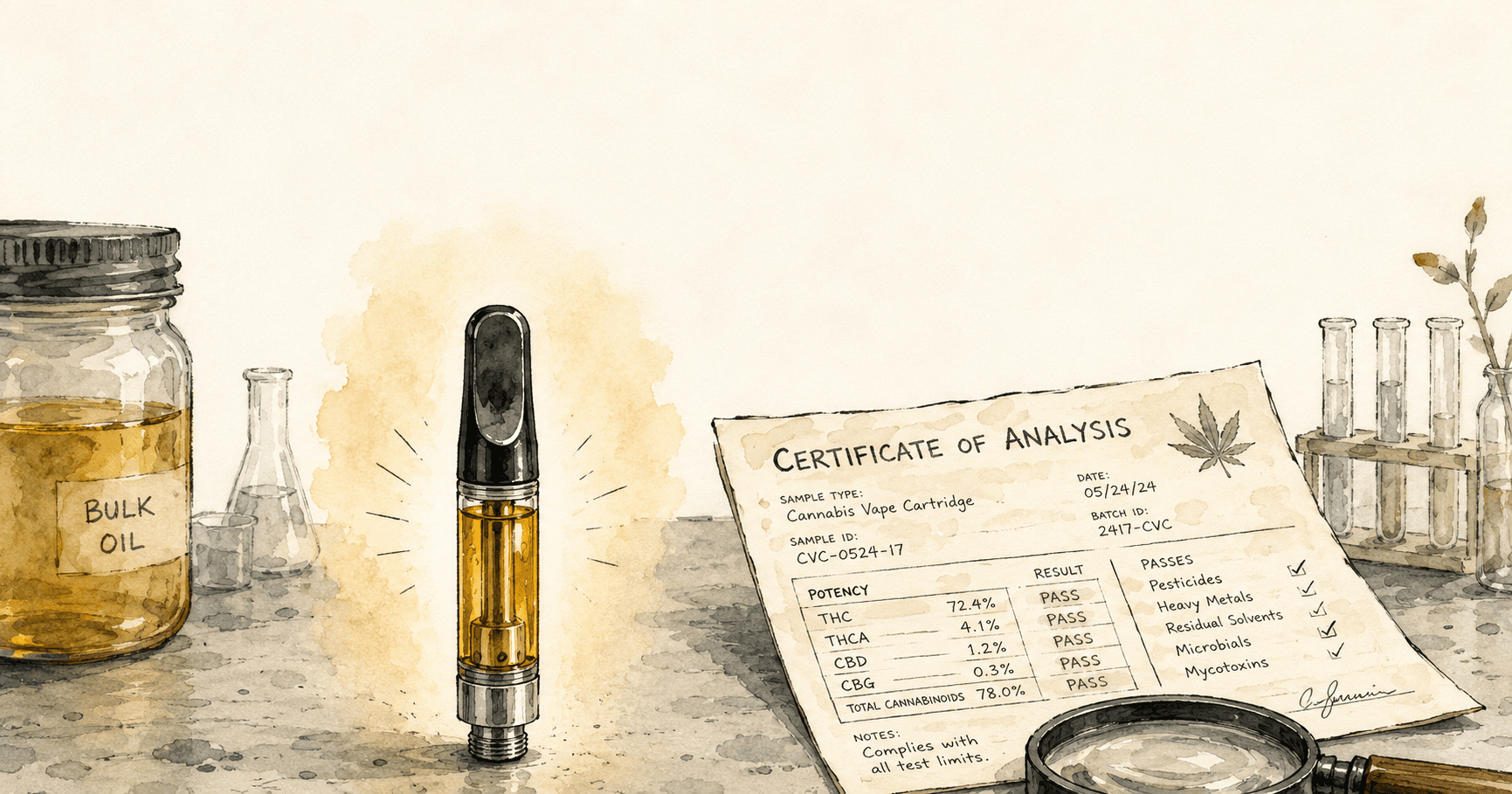
- Check the sample type on the COA. When you scan the QR code on a box, the report should say the sample was a finished product or finished good, not bulk oil or raw concentrate. This is the single most useful line on the whole document and almost nobody reads it. If it says bulk, the test didn't see the hardware.
- Match the batch ID. The COA has to correspond to the exact batch in your hand. An old or mismatched COA is no COA at all.
- Look at the hardware. Glass tank, ceramic coil. The tap test tells you glass from plastic in two seconds. A brand that uses glass usually says so, because it costs more and they want the credit.
- Check the recall database. California's public recall portal lists every pulled product. It takes thirty seconds and it's the closest thing to a brand background check you have.
Frequently Asked Questions
Do vape cartridges leach chemicals into the oil?
They can. Plastic tanks, low-quality metal coils, and some adhesives can shed compounds into cannabis oil over time and heat, including microplastics, heavy metals, and plasticizers. That's why a cartridge should be tested in its finished, filled form rather than as bulk oil, and why glass-and-ceramic hardware matters.
Why do cannabis vapes have to be tested as a finished product?
Because the cartridge can change the oil. Testing bulk concentrate before it's filled misses any contamination that leaches out of the hardware once the oil sits inside it. States like California and Missouri require the regulated test to run on the product in the form the customer actually buys it.
Is it legal to sell a vape tested only as bulk oil?
In most regulated markets, no. California and Missouri both require finished-product testing. A June 2026 Missouri recall pulled hundreds of cartridges specifically because they had been tested as bulk concentrate rather than as filled cartridges.
How can I tell if my cart was tested as a finished product?
Scan the QR code on the box and read the sample type field on the COA. It should say finished product or finished good, not bulk oil or raw concentrate. Confirm the batch ID on the report matches the one on your package while you're there.
Does finished-product testing guarantee my cart is safe?
No. A COA is a snapshot of representative cartridges at the time of testing, not the specific cart in your hand months later. Leaching is partly a function of time and heat, so finished-product testing narrows the gap between what's certified and what's consumed without closing it entirely. Good hardware is what keeps an aging cartridge close to its COA.
The Closing
The Missouri recall reads, on the surface, like an argument about forms and deadlines. It isn't. Underneath the procedural language is a simple idea that the whole testing system is built on, which is that the thing you certify has to be the thing the customer actually uses. A barrel of clean oil is a real fact about a barrel. It is not a promise about the cartridge that barrel becomes. The brands worth trusting are the ones that test the cartridge, build it out of materials that won't undermine the test, and tell you which is which. The rest are certifying a barrel and hoping you never ask which one you're holding.
Want more cannabis intel?
Join The Dealers Diary — weekly strain spotlights, industry news, and insider access.
Subscribe Free