What Makes a Vape Cart Smooth? The Hardware That Kills Harshness
The Hit That Makes You Cough Isn't Always the Strain
You take a pull, and instead of flavor you get a hot scratch at the back of your throat. Maybe you cough. The reflex is to blame the strain, or your tolerance, or to decide you just got a bad cart. Sometimes that's right. Most of the time it isn't.
Harshness is an engineering outcome, not a personality trait of the oil. A hit feels smooth or harsh based on how hot the vapor is when it hits your throat, how much air is diluting it, and what's actually in the oil besides cannabis. All three of those are decisions somebody made, either the person who built the hardware or the person who filled it. Once you know what they are, you can fix a harsh cart at the battery, and you can spot a smooth one before you buy it.
I'm Nick. I run extraction and hardware at Halara, which mostly means I spend a lot of time thinking about why carts do the annoying things they do. Clogging is one I've written about before, and one where we later went and read what other California brands disclose about their hardware. Harshness is the other big one, and it's more fixable than most people think.
What Makes a Vape Cart Smooth?
A vape cart is smooth when the vapor reaches your throat cool, evenly diluted with air, and free of anything that isn't cannabis oil or cannabis-derived terpenes. That comes from three things working together: a battery running at the right voltage, an airflow path that cools and dilutes the vapor on its way up, and an atomizer that heats the oil evenly instead of scorching it. Get all three right and even high-potency oil goes down easy.
Everything below is just those three factors in more detail, plus the stuff to avoid.
What "Harsh" Actually Is: Vapor Temperature
Harshness is mostly heat. When the heating element gets too hot, three bad things happen at once. The vapor itself arrives hot and dry, which your throat reads as irritation. The terpenes, which are the most heat-sensitive part of the oil, start to degrade and evaporate, so you lose the flavor that would have rounded the hit off. And at high enough temperatures you start creating thermal degradation byproducts you'd rather not inhale.
There's real research on this. A thermography study of vaporizer heating coils found that only temperature-controlled systems reliably kept coil temperatures under 400°C through a full puff, and that staying under that line reduces the likelihood of harmful thermal degradation products. Uncontrolled hardware spikes past it. That temperature spike is the same thing you feel as harshness. Cooler vapor is smoother vapor, and it's also cleaner vapor. Those aren't two goals, they're the same goal.
So when a cart hits harsh, the first question isn't "is this oil bad," it's "how hot is this thing running."
Voltage and Temperature: The Setting That Matters Most
If you use a 510 cart with a reusable battery, this is the single biggest lever you have, and it's free.
Voltage controls how much power reaches the coil, which controls how hot the vapor gets. For most cannabis oil the smooth range sits between 2.4V and 3.2V. Terpene-rich oils (live resin, resin sauce, live rosin) belong at the low end, roughly 2.4V to 2.8V, because their flavor compounds cook off first. Distillate can handle a little more heat before it suffers. If your battery has a color-coded dial, the lowest one or two settings are almost always where the flavor lives.
Here's the move when a hit feels harsh: drop the voltage by 0.1V and take a shorter pull. Long pulls keep the coil energized, so the vapor keeps heating the whole way up the mouthpiece. A two-second draw at 2.6V is smoother than a five-second draw at 3.0V nearly every time. Most people run their battery too hot and pull too long, then blame the cart.
AIO devices (all-in-one, battery built in) take this decision away from you, which is exactly why the hardware inside them matters so much. You can't dial an AIO down. Whoever built it already picked your voltage. If they tuned it to move thick oil by running hot, you're stuck with a harsh hit and no knob to fix it. That's the whole argument for buying an AIO from someone who actually engineered the thermal side.
Airflow: Why a Smooth Draw Isn't Just Marketing
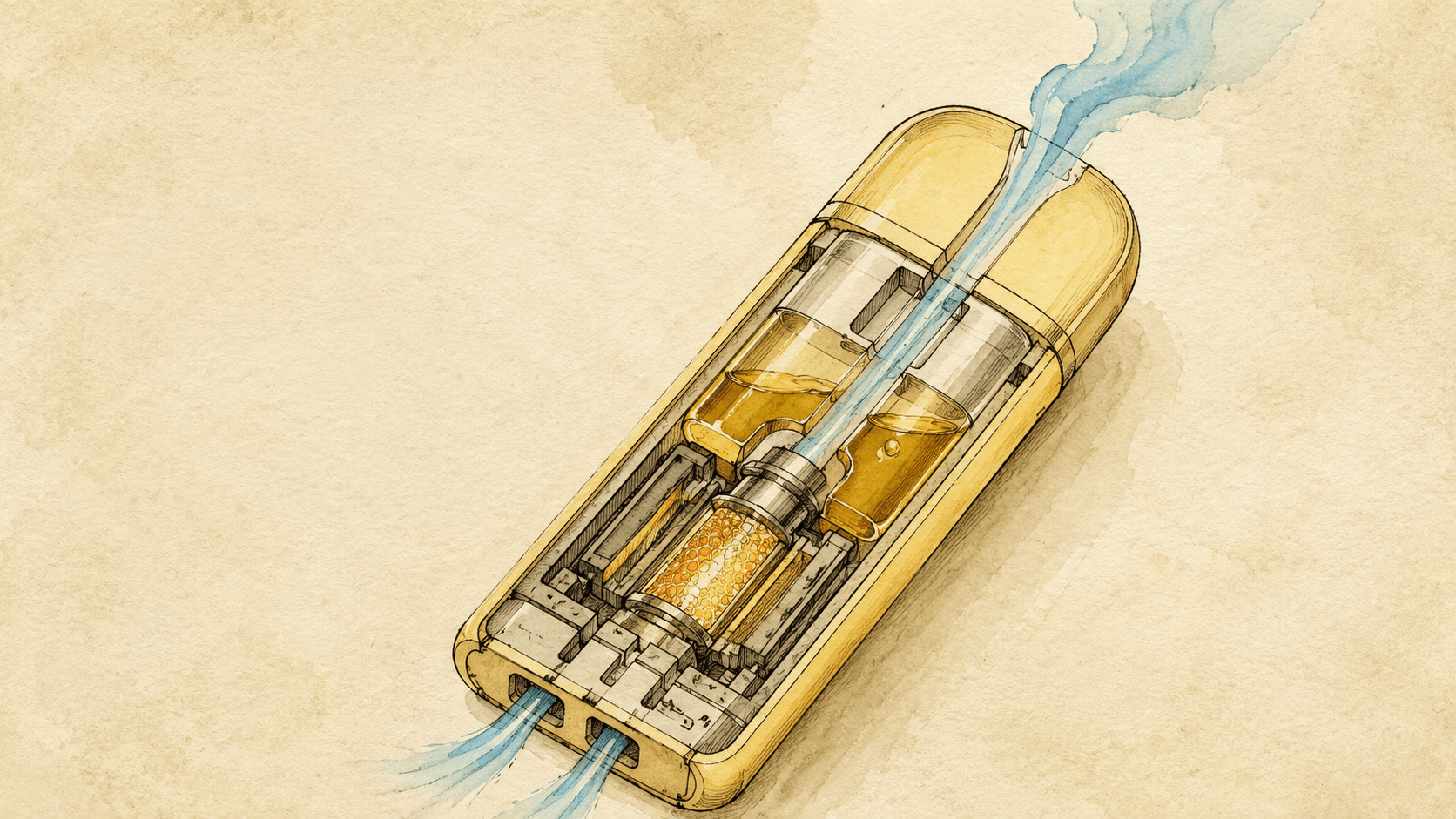
Vapor doesn't reach your mouth straight off the coil. It travels up an airflow channel, and the air it mixes with on the way is what cools and dilutes it. Restrict that airflow and the vapor arrives dense and hot. Open it up and it arrives cooler and easier on the throat.
This is where "dual airflow" is more than a spec-sheet word. Two intake ports at the base of the cart, instead of one, pull air more evenly across the heating element and blend more air into the vapor stream. I go deep on the fluid dynamics in the clogging piece, because even airflow is also what keeps oil from condensing and blocking the channel. For smoothness, the relevant part is simpler: more evenly distributed air means cooler, better-diluted vapor and less of that single-jet scorch you get when everything is pulled through one narrow hole.
You can feel the difference in the draw resistance. A cart that makes you pull hard is forcing hot vapor through a tight path. A cart with an open, even draw is doing some of the cooling work for you.
The Oil: Terpenes, Viscosity, and What Gets Cut
Smoothness isn't only hardware. The oil itself either helps or fights you.
Terpenes are the flavor and aroma compounds in cannabis, and they're also a natural solvent that thins the oil. A cart with an intact, cannabis-derived terpene profile flows better and, because it doesn't need as much heat to move, tends to hit cooler. Strip the terpenes out (which is what happens with plain distillate) and you often get a flatter, hotter, more one-note hit unless flavor is added back.
Here's the part most "clean ingredients" posts skip: it's not just whether the terpenes are real, it's how much of them are in there. A cart's oil naturally carries a certain terpene percentage, whatever that specific strain produces. When a brand wants louder flavor on cheap, flat distillate, the easy fix is to add extra terpenes back in, cannabis-derived or not, well past what the strain actually makes. That's over-terping, and you can feel it: a tight, chemical burn low in the throat and lungs, the one people describe as coughing out a lung, even though the label says cannabis-derived terpenes and reads clean on paper. Terpenes are still oil, and oil at a high enough concentration irritates a throat no matter where it came from. The goal isn't fewer terpenes for its own sake, it's terpene content that matches what the strain would actually carry instead of one cranked up to disguise thin oil underneath.
The part to actually worry about is what some products add to thin the oil out on the cheap. Cutting agents like PG (propylene glycol), VG (vegetable glycerin), and especially PEG (polyethylene glycol) make oil flow easily, but they vaporize into harsher, more irritating compounds than cannabis oil does. This is the ingredient category that was at the center of the 2019 vape crisis (vitamin E acetate specifically), and it's the reason "what's in the oil" is a health question, not just a comfort one. On tuned hardware, clean full-spectrum oil should be all cannabis. The ingredient line you want to see is short: cannabis oil, cannabis-derived terpenes. Anything you can't pronounce is there to cut cost, and it usually costs you the throat.
Here's the counterintuitive one, and I'll say it plainly because most brands won't: chasing the highest possible THC number can make a cart harsher. Higher-potency oil is thicker. Thicker oil needs more heat or more airflow to move, and if the brand solves that by running the battery hotter, you get a harsher hit in the name of a bigger number on the label. Potency and smoothness are separate engineering problems. A cart that's tuned as a system, oil viscosity matched to atomizer to voltage, beats a cart that just maxed out the TAC and hoped.
The Atomizer: Ceramic vs. Cotton, and Why Even Heat Matters
The atomizer is the part that turns oil into vapor, and how evenly it heats decides how smooth every hit is.
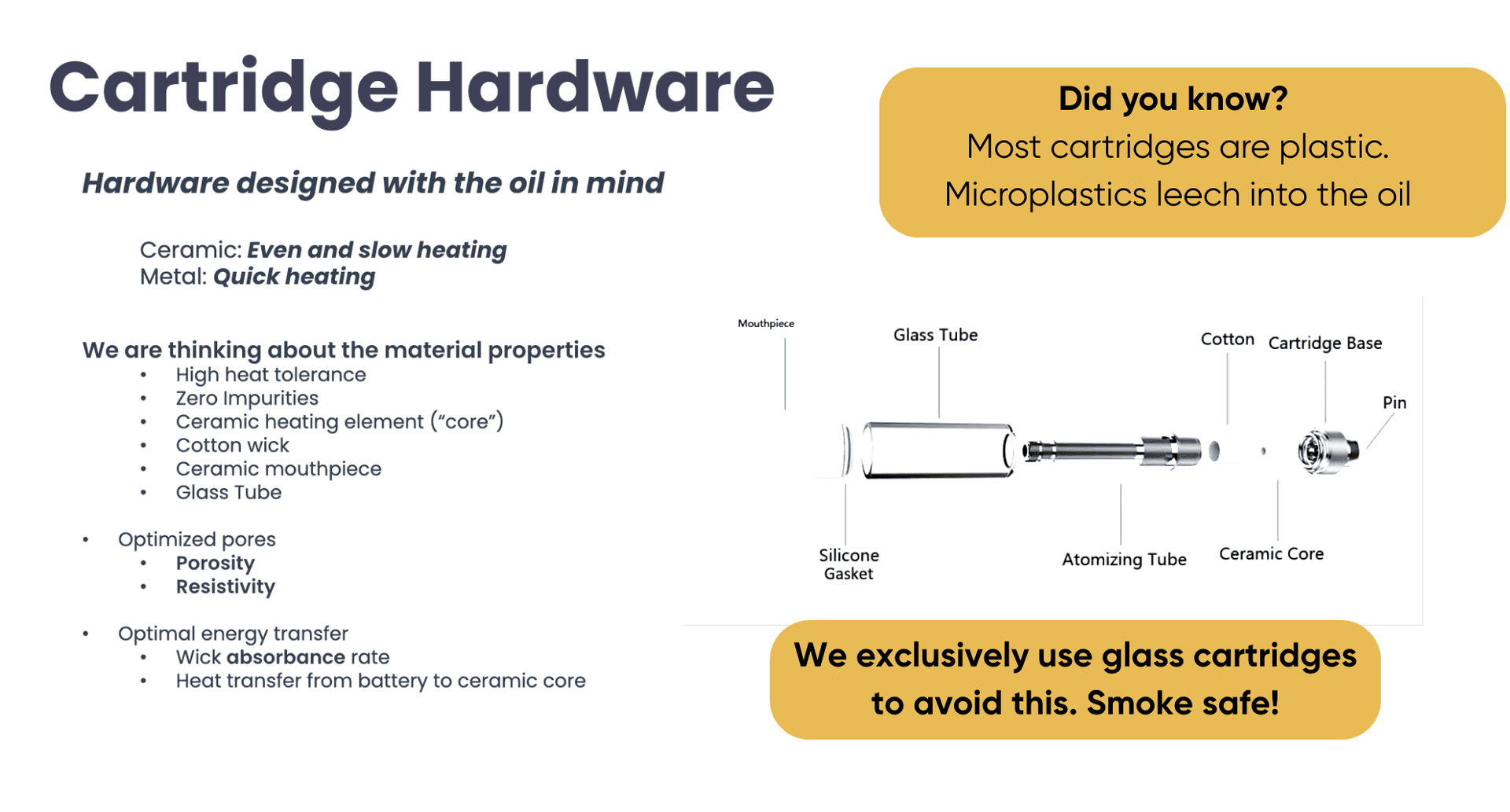
Cheap carts use a cotton wick wrapped around a coil. Cotton chars. Once it does, you get that burnt-popcorn taste and a hot, acrid hit, and it only gets worse as the cart empties. A quality ceramic atomizer heats the oil across its whole surface at once, so nothing scorches in one spot while sitting cold in another. Even heat means even vaporization means a hit that tastes the same on the last pull as the first.
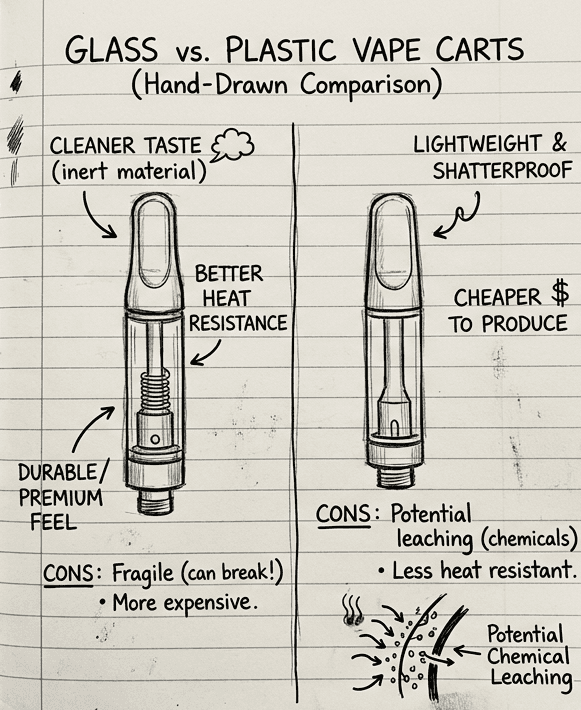
Ceramic quality matters here too, not just ceramic-versus-cotton. Porosity has to be consistent, or the oil gets drawn unevenly and you're back to hot spots. Cheap ceramic also raises a second issue: heavy metals. Research on metals in vaporizer aerosols has found that lead, nickel, and chromium can leach out of low-grade hardware into the vapor, which is both a health problem and, at the margins, a taste-and-harshness one. Better hardware, tighter tolerances, cleaner hit. It's all connected.
How to Hit a Cart Without Coughing
If you already own the cart, most harshness (and the cough that comes with it) is fixable without buying anything:
- Lower the voltage. Start at the bottom of your battery's range (around 2.4V to 2.8V for anything terpene-rich) and only go up if the vapor feels weak. Drop 0.1V any time it scratches.
- Take shorter pulls. Two to three seconds. Long draws keep heating the vapor the whole way up.
- Warm a cold cart. Oil left in a cold car or pocket thickens, which makes the battery work harder and the hit run hotter. Warm it in your hand for a minute first.
- Prime it. A quick, gentle pull with the battery off (or a few seconds of rest after activating) lets oil saturate the atomizer so you're not pulling against a half-dry coil.
- Store it upright at room temperature. Keeps the oil where it belongs and keeps viscosity in the range the hardware expects.
If you're still shopping, buy for smoothness before you buy for the potency number:
- Look for dual airflow (two intake holes at the base) and an open, easy draw.
- Look for a ceramic atomizer, and a brand that says so. If they don't mention it, assume cotton.
- Read the ingredient line. You want cannabis oil and cannabis-derived terpenes, nothing else. No PG, VG, PEG, or "natural flavors." Our COA guide and safe-vaping guide walk through how to verify this.
- Watch for over-terping. A cart can be 100% cannabis-derived and still be loaded with more terpenes than the strain naturally makes, just to fake flavor on flat oil. That's a common cause of the harsh, chemical-burn cough, separate from cutting agents entirely.
- Check the recall record at recalls.cannabis.ca.gov before you buy a brand you don't know. Contamination shows up as harshness too.
What We Do at Halara
Short version, because this post is about carts in general, not a pitch.

Halara makes high-THC all-in-one vapes in California engineered against the two things that ruin carts: clogging and harshness. Our AIOs use dual airflow and a ceramic atomizer spec'd for even heat, and because an AIO doesn't let you pick your own voltage, we tune the whole system (oil viscosity matched to the atomizer matched to a battery that runs cool) so the default hit is the smooth one. The oil is cannabis and cannabis-derived terpenes, nothing cut in, and we don't over-terp to fake flavor on flat oil either. Terpene content is dialed to what the strain actually carries, not maxed out to mask thin distillate, which is the difference between tasting a strain and coughing through it. Our high-THC line runs 90 to 94% TAC depending on the batch, and it sits at $25 to $29 across 300-plus dispensaries because building the smooth version costs more than building the cheap one. That's the trade we made.
If a cart of ours ever hits harsh on you, call me. My number's on the bag, and I'd genuinely like to know.
What Customers Actually Say
We don't have to make the smoothness argument alone. Roughly one in five of our verified customer reviews mentions smoothness without anyone asking about it, and these are a few, word for word:
"You have the smoothest, most high quality cartridges that I have come across." — Christine H., A Therapeutic Alternative, Sacramento, CA (verified buyer, 4/5)
"Mechanically it's the best vape. It's the smoothest draw. The flavors are clean." — Janis, Jane / Organicann / Sweet Spot (verified buyer, 5/5)
"It's not harsh on the throat like other carts. Taste 15/10 and smackin." — Tito B., Royal Healing, Lompoc (verified buyer, 5/5)
"No harsh chemical taste. Will rebuy forever." — Leah K., verified buyer (5/5)
Frequently Asked Questions
Why is my vape cart harsh?
Harshness almost always comes down to vapor temperature. If your battery runs too hot, or the atomizer heats unevenly and scorches the oil, you inhale hot vapor plus a little thermally degraded material, and that scratches the throat. Cutting agents like PG, VG, or PEG make it worse. Drop your voltage, take shorter pulls, and check that the oil is real cannabis oil and cannabis-derived terpenes, nothing thinned.
What is the best voltage for a THC cart?
For most carts, 2.4V to 3.2V. Live resin, resin sauce, and rosin are terpene-rich and heat-sensitive, so keep those at the low end, roughly 2.4V to 2.8V, to protect flavor and stay smooth. Distillate can take a touch more. If a hit feels harsh, drop 0.1V at a time before you assume the cart is bad.
Does higher THC mean a harsher hit?
Not directly, but it's correlated. Higher-potency oil is thicker, so some brands run the battery hotter to move it, and hotter vapor is harsher. Potency and smoothness are separate engineering problems. A well-built 90-plus percent TAC cart on tuned hardware hits smoother than a cheap 80 percent one on a hot generic battery.
Why does my vape make me cough?
Coughing is your throat reacting to hot or irritating vapor. The usual causes are too-high voltage, pulls that are too long (which lets the vapor keep heating), a dry or charred atomizer, or additives in the oil. Cool it down: lower the voltage, shorten the inhale, let the cart warm to room temperature if it's cold, and buy oil with a clean ingredient list.
Why does my vape burn my throat?
That burn is vapor arriving too hot, and it has a few usual causes. Voltage set too high for the oil, an atomizer heating unevenly so one spot scorches while the rest stays cold, or a dry hit off a cart that's running low on oil and pulling against a bare coil. Overloaded terpenes and cutting agents like PG, VG, or PEG make a hot hit burn worse. Drop the voltage, take a shorter pull, and don't keep hitting a cart once it's running dry.
How do you hit a cart without coughing?
Lower the voltage to the bottom of your battery's range, take a short two- to three-second pull instead of a long drag, and let the vapor sit in your mouth for a beat before you inhale so it cools further. Warm a cold cart in your hand first, since cold oil is thicker and makes the battery run hotter to move it. If you're still coughing after all that, the oil itself is probably the problem: over-terped or cut oil will make you cough at any voltage.
Why do I cough more on some carts even at low voltage?
Usually it's the terpene load, not the voltage. Terpenes are a real, cannabis-derived ingredient, but they're still oil, and a cart can carry far more of them than any actual strain produces, especially when a brand is using them to fake flavor on flat, low-terpene distillate. That extra volume is what causes the tight, chemical burn low in the throat and lungs that people describe as coughing out a lung, even on oil that lists as 100% cannabis-derived. Look for terpene content that matches what the strain would naturally carry, not one maxed out to compensate for boring oil underneath.
Where can I find Halara carts?
Halara's high-THC AIOs and resin sauce carts are stocked across 300-plus California dispensaries, plus Washington and New York. Use our store locator to find the nearest one.
Sources
- Thermography of cannabis extract vaporization cartridge heating coils in temperature- and voltage-controlled systems — peer-reviewed study on coil temperature and thermal degradation
- Metals in Cannabis Vaporizer Aerosols: Sources, Possible Mechanisms, and Exposure Profiles — Chemical Research in Toxicology, on heavy-metal leaching from hardware
- California DCC Cannabis Recall Portal — public recall lookup by brand
Want more cannabis intel?
Join The Dealers Diary — weekly strain spotlights, industry news, and insider access.
Subscribe Free