Types of Cannabis Concentrates: A Complete Guide
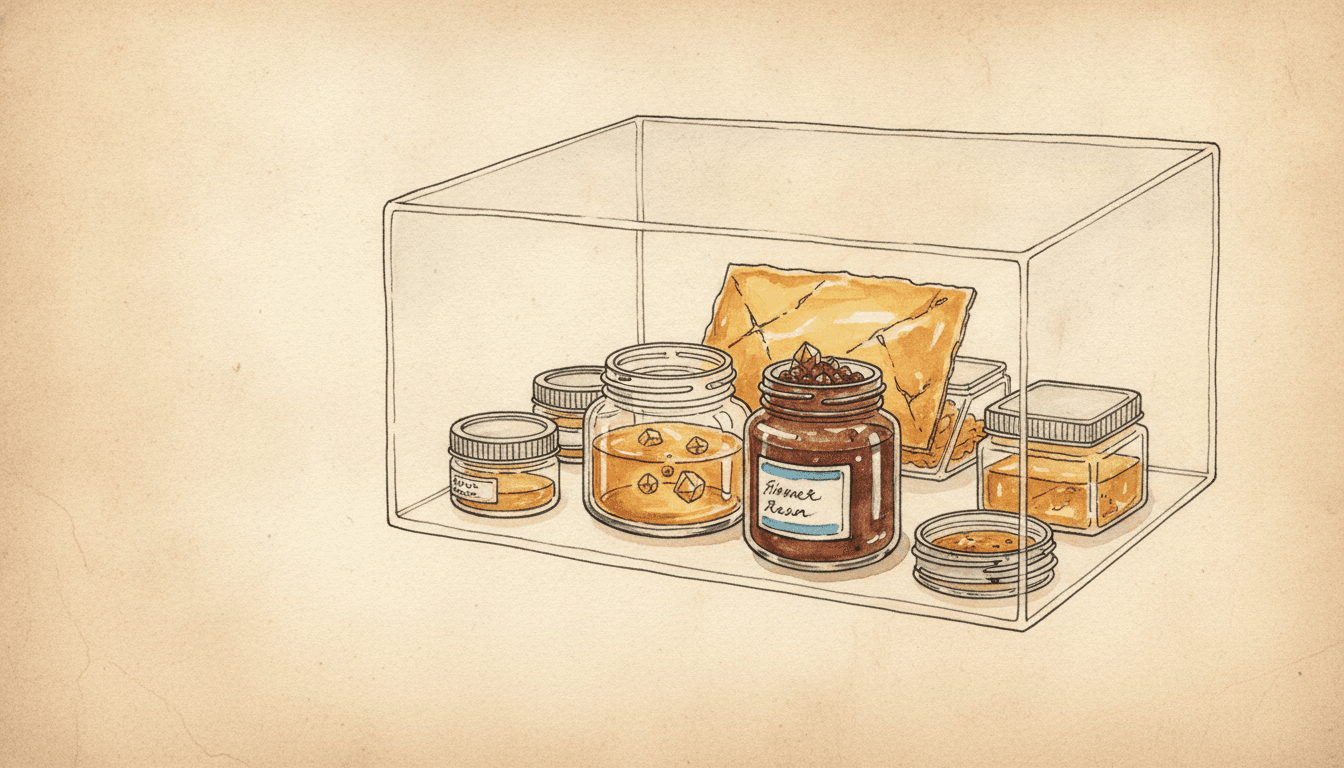
Every Case Labeled "Concentrates" Is Actually Eight Products
Walk up to a dispensary case labeled "concentrates" and you'll see jars, syringes, and vape carts that all get filed under one word, and they are not remotely the same thing. One jar is nearly flavorless, 90% THC, and made in an industrial ethanol still. The jar next to it is fresh-frozen flower pressed with nothing but ice water and a hydraulic press, and it costs three times as much for a reason. A budtender who's rushed will wave at the whole case and call it "concentrates." That's technically true and functionally useless.
I'm Nick. I run extraction and hardware at Halara, and the question I get asked most at events isn't "which one's the strongest." It's "what am I actually looking at." Fair question. The word "concentrate" just means cannabinoids and terpenes pulled out of the plant and concentrated into something more potent than flower. Everything else, how it's pulled out, what's still attached to it when it's done, is the part that actually changes your experience.
Here's the full landscape, sorted by the two things that actually matter: what the concentrate started as, and what was used to get it out. If you landed here because of 710, the oil holiday on July 10, this is the map worth reading before you shop.
What Is a Cannabis Concentrate?
A cannabis concentrate is any product made by isolating cannabinoids and terpenes from the plant material, using solvents, heat, or pressure, to produce something far more potent than dried flower. Flower typically tests 15-25% THC. Concentrates start around 60% and go up from there. The category includes everything from oily vape cartridges to hard, glass-like shatter to loose kief you sift out of a grinder.
The split that actually organizes this whole category is solvent versus solventless, and inside solvent-based concentrates, a second split: what condition the plant was in when it got extracted.
Solvent vs. Solventless: The Split That Actually Matters
Most of what confuses people at the dispensary counter comes down to one axis: did a chemical solvent touch this plant material, or didn't it.
Solvent-based concentrates use a liquid or gas (butane, propane, CO₂, or ethanol) to strip cannabinoids and terpenes off the plant, then purge that solvent back out under vacuum. Distillate, live resin, cured resin, resin sauce, wax, shatter, and budder are all in this bucket. The solvent is a tool, not an ingredient. A properly purged product shows non-detect on residual solvents on its COA. But the extraction method (and how well the purge was done) has a real effect on what's left in the final product.
Solventless concentrates use nothing but water, heat, and pressure. Rosin, live rosin, bubble hash, and dry sift are in this bucket. Nothing chemical ever touches the plant. It's the simpler process on paper and the harder one to do well in practice, which is why solventless products carry the highest prices in the case.
Neither side is automatically "better." A well-made live resin can taste more vivid than a poorly pressed rosin, and vice versa. What matters is execution, not which axis a product sits on.
The Distillate Family: Potency First, Flavor Added Back
Distillate is the workhorse of the industry, and understanding it explains most of the rest of the category.
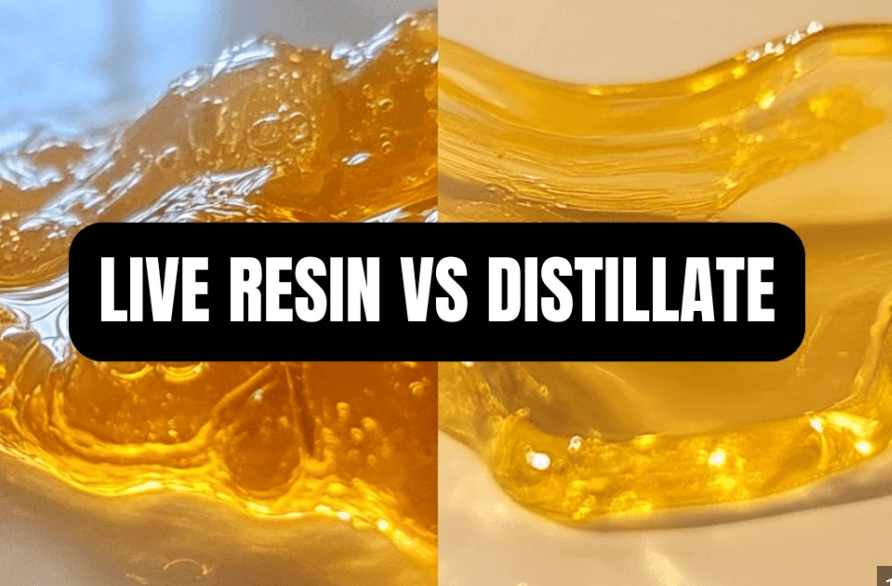
Cannabis flower or trim gets extracted (usually with ethanol or CO₂), then refined through short-path distillation, essentially boiling off and recondensing compounds by temperature until what's left is nearly pure THC. Clear, odorless, flavorless, and typically 85-95% THC. Since distillation strips out the terpenes along with everything else, flavor gets added back afterward, either with cannabis-derived terpenes pulled from a separate extraction or cheaper botanical terpenes sourced from fruit and herbs. Both work. Neither is the plant's own flavor, which is the whole trade-off distillate makes: highest raw potency, lowest cost, and a flavor profile that was built in a lab rather than grown in a field. We go deep on how to tell the difference in our live resin vs. distillate breakdown.
The Fresh-Frozen Family: Live Resin, Resin Sauce, Rosin, Live Rosin
This is where "concentrate" starts meaning something closer to "the plant, just stronger."
The defining move across this whole family is flash-freezing the flower within hours of harvest instead of drying and curing it first. Cannabis terpenes start degrading the moment a plant is cut, and freezing stops that clock. What survives into the concentrate is closer to what was actually in the living plant, not what's left after weeks of drying.
- Live resin uses cold hydrocarbon solvent (butane or propane) on fresh-frozen flower, then purges the solvent out. Typically 65-85% THC, with the full spectrum of the strain's original terpenes intact. We cover the whole process in What Is Live Resin.
- Cured resin is the same hydrocarbon extraction, but on dried, cured flower instead of fresh-frozen. It's cheaper to produce and tastes earthier and more muted, since the volatile terpenes already degraded during the cure.
- Resin sauce starts as live resin, then goes through a separation step where THCA crystallizes into diamonds and the terpene-rich liquid pools around them as "sauce." That separation concentrates the flavor even further, typically landing at 70-90% THC. We break down the full comparison in Resin Sauce vs. Live Resin vs. Rosin.
- Rosin skips solvent entirely. Flower or hash gets pressed between heated plates until the oil squeezes out under heat and pressure alone, no butane, propane, CO₂, or ethanol at any point. Typically 60-80% THC.
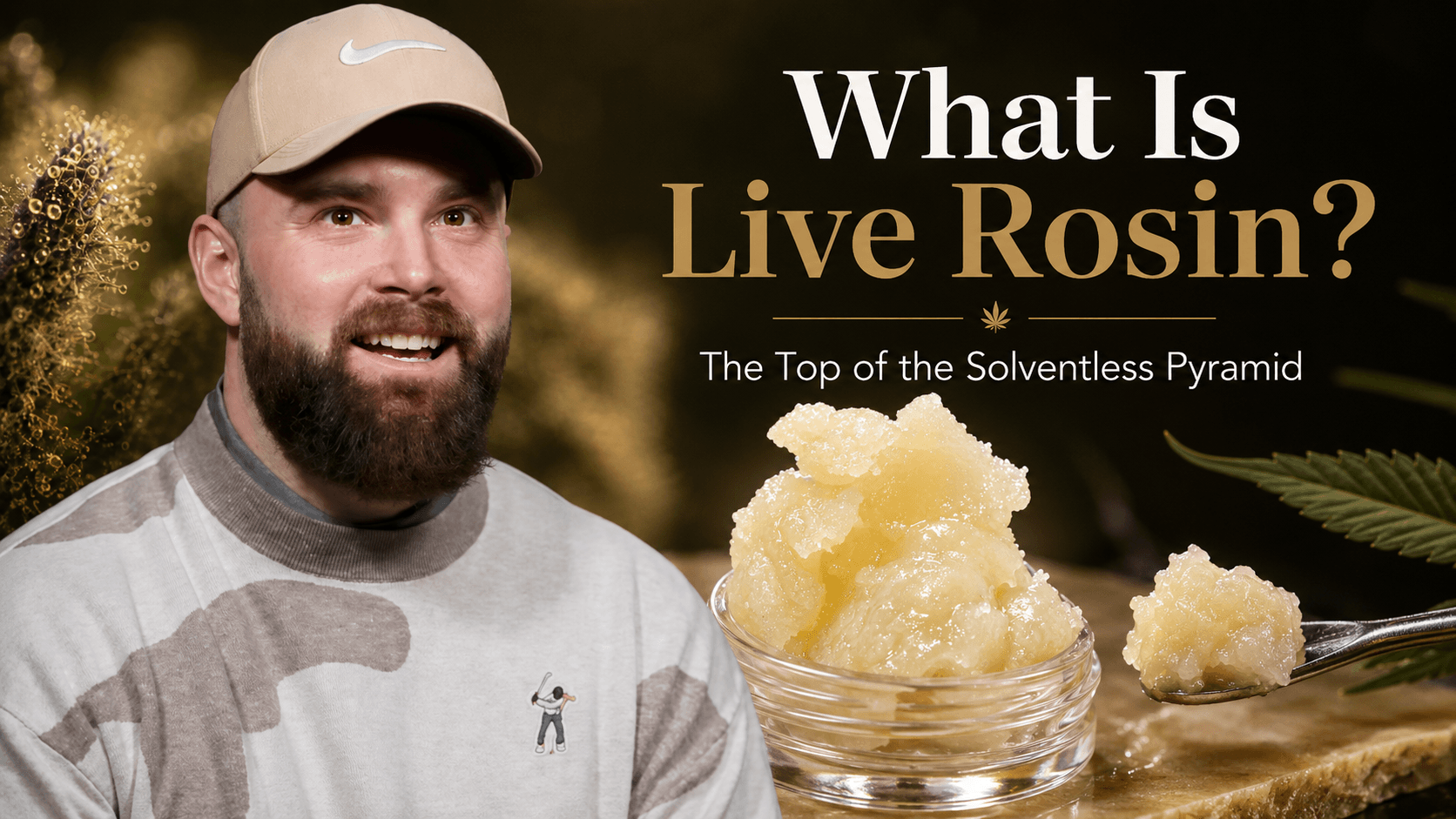
- Live rosin is rosin pressed from fresh-frozen material (usually turned into ice water hash first, then pressed). It combines solventless extraction with fresh-frozen terpene preservation, which is why it commands the highest prices in the category, typically 70-85% THC. The full process is in What Is Live Rosin.
If you only remember one thing from this section: "live" means fresh-frozen input, and solventless means no chemicals ever touched the plant. Those are two separate axes, and a product can be either, both, or neither.
Wax, Budder, and Shatter: Same Oil, Different Texture
Wax, budder, crumble, and shatter usually start as the same thing, BHO or PHO (butane or propane hash oil) extracted from either fresh-frozen or cured flower, and the difference between them comes down to what happens during the purge, the step where residual solvent gets vacuumed out.
Shatter is purged and cooled without agitation, so it hardens into a glassy, translucent sheet that snaps like hard candy. Wax and budder get whipped or agitated during the purge, which introduces air and produces a softer, opaque, moldable texture, sometimes creamy, sometimes crumbly depending on temperature and technique. Flavor and potency are usually comparable between the two. According to the National Institute on Drug Abuse, concentrates in this category (dabs, wax, and shatter) commonly test at 60-90% THC, which is why they're consumed in small amounts, usually vaporized off a hot surface ("dabbing") rather than smoked like flower.
Texture is genuinely just preference here. The thing worth checking isn't wax versus shatter, it's whether the COA shows a clean residual solvent panel, since this whole family depends on a thorough purge.
THCA Diamonds and Isolate: As Close to Pure as It Gets
THCA diamonds are crystallized, near-pure tetrahydrocannabinolic acid, the raw acidic compound that converts to THC when you apply heat. They form naturally during resin sauce separation, or get isolated deliberately from live resin or distillate, and they can test at 99%+ THCA on a COA.
Here's the catch that trips people up: 99% THCA does not mean 99% THC once you actually use it. Decarboxylation, the heat reaction that converts THCA to THC, releases a carboxyl group as CO₂ and water vapor, and that lost mass matters. THCA's molecular weight is about 358 g/mol; THC's is about 314 g/mol. Do the math and you get a conversion factor of roughly 0.877, meaning 99% THCA converts to about 87% actual THC once it's been heated. It's still extremely potent. It's just not the number printed on the jar.
Isolate is the flavorless, single-molecule version of this, pure THC crystalline powder with the terpenes and everything else stripped out entirely. It's the purest form of THC that exists and, unsurprisingly, the least interesting to actually smoke or vape on its own.
If you want the full chemistry on why 99% THCA doesn't mean 99% THC, we wrote a dedicated breakdown.
Kief and Hash: The Least Processed Concentrates
Before extraction technology existed, this was the entire concentrate category, and it's still around because it works.
Kief is the loose, powdery trichome heads that collect in the bottom of a grinder or get sifted through a mesh screen, no water, no heat, no solvent, just mechanical separation. Bubble hash (also called ice water hash) uses cold water and agitation to knock trichomes off the plant, which then get collected through progressively finer mesh screens. Dry sift does the same separation with dry ice or friction instead of water.
These are the rawest concentrates in the case, closest to just "more trichomes, less plant." They're also the starting material for rosin (hash gets pressed) and, at the high-quality end, for full-melt hash that dabs clean with almost no residue.
The Full Comparison
| Concentrate | Input | Extraction | Solvent | Typical THC |
|---|---|---|---|---|
| Distillate | Cured flower/trim | Distillation | Ethanol/CO₂ | 85-95% |
| Cured resin | Cured flower | Hydrocarbon | Butane/propane | 65-80% |
| Live resin | Fresh-frozen flower | Hydrocarbon | Butane/propane | 65-85% |
| Resin sauce | Fresh-frozen flower | Hydrocarbon + separation | Butane/propane | 70-90% |
| Rosin | Flower or hash | Heat + pressure | None | 60-80% |
| Live rosin | Fresh-frozen hash | Heat + pressure | None | 70-85% |
| Wax/budder/shatter | Fresh-frozen or cured flower | Hydrocarbon (purge variant) | Butane/propane | 60-90% |
| THCA diamonds | Live resin or distillate | Crystallization/isolation | Varies | 90-99%+ THCA |
| Kief/hash | Raw flower | Mechanical/ice water | None | Varies widely |
How to Identify a Quality Concentrate
The category is wide, but the checklist for telling a good one from a bad one doesn't change much across types.
- Published COA. Every legitimate brand shows batch-specific lab results, potency, pesticides, heavy metals, residual solvents. If you can't find it via QR code or on the brand's website, that's the first red flag, and it matters more here than almost anywhere else in cannabis. A PubMed review on dabbing specifically flags contamination risk (solvent residue, pesticide concentration from the extraction process) as a real concern in this product category, which is exactly what a clean COA is there to rule out.
- Ingredient transparency. "Cannabis oil, cannabis-derived terpenes" is what you want to see. "Natural flavors" or an ingredient list longer than the product needs is a sign something got added to cut cost.
- Matches its own label. A "live" product should specify fresh-frozen input. A "solventless" product should show non-detect on residual solvents, not just "trace amounts."
- Color and clarity appropriate to type. Shatter should be clear, not cloudy. Rosin should be light to amber, not dark and muddy. Diamonds should actually look crystalline, not just chunky.
- Aroma. A concentrate that preserved its terpenes should smell strong. If a "live resin" or "rosin" is flat and odorless, the terpenes didn't survive the process, whatever the label says.
What We Do at Halara
We don't touch every category in this guide. Halara makes a smooth, high-THC AIO line built on distillate (94% TAC, anti-clog hardware, $25-29 in California and available across 300+ dispensaries in California, Washington, and New York), and on the concentrate side, we make Resin Sauce and solventless rosin cartridges, both whole-plant, fresh-frozen, cannabis-derived terpenes only, no additives.
We picked those two because they're the concentrates that actually reward doing it right: resin sauce for people chasing the loudest possible flavor, rosin for people who want zero solvent in the equation. Every batch of both gets a published COA. If you want the deeper version of how we build the resin sauce cartridges specifically, Nick wrote a whole piece on it.
Frequently Asked Questions
What are the different types of cannabis concentrates?
The main categories are distillate (nearly pure THC, terpenes added back), live resin and cured resin (hydrocarbon-extracted, terpenes preserved or degraded depending on the input), resin sauce (live resin separated into THCA diamonds and terpene liquid), rosin and live rosin (solventless, made with only heat and pressure), wax/budder/shatter (BHO whipped or cured to different textures), THCA diamonds (near-pure crystallized THCA), and kief or hash (the least processed, just collected or washed trichomes).
What is the strongest type of cannabis concentrate?
By raw THC percentage, THCA diamonds and distillate lead, both regularly testing in the 90s. But "strongest" and "most potent-feeling" aren't the same thing. Live resin, resin sauce, and rosin test lower on paper (60-90% depending on type) but keep the plant's full terpene and minor-cannabinoid profile, which many people report as a fuller, more dimensional high than the raw THC number suggests.
Is dabbing concentrates safe?
Dabbing delivers a large dose of THC in a single inhale, which raises the risk of side effects like a racing heart or overwhelming high, especially for less experienced users. The bigger safety variable is the product itself: buy from a licensed source with a published COA showing non-detect on residual solvents and pesticides, and start with a small dab. Unregulated concentrates carry real contamination risk.
What's the difference between wax and shatter?
Same starting material, different handling after extraction. Shatter is purged and cooled without agitation, so it hardens into a glassy, translucent sheet. Wax (also called budder or crumble depending on consistency) is agitated while purging, which whips air into it and produces an opaque, moldable texture. Flavor and potency are usually similar. The difference is mostly textural and a matter of preference.
What is THCA diamond?
THCA diamonds are crystallized, near-pure tetrahydrocannabinolic acid, the raw acidic form of THC that converts to THC when heated. They form naturally during resin sauce separation or get isolated deliberately, and they can test at 99%+ THCA on a COA. Because of the molecular weight lost in decarboxylation, that translates to roughly 87% actual THC once you dab or vape it, not 99%.
Are cannabis concentrates legal everywhere cannabis is legal?
In licensed adult-use and medical states, yes. Concentrates go through the same testing and packaging requirements as flower and vape carts. The grey market also sells concentrates under the same names (wax, shatter, live resin) with none of that testing, which is where most of the real safety risk lives. Buying from a licensed dispensary with a scannable COA is the actual safeguard, not the product category.
Where can I buy cannabis concentrates?
Halara's Resin Sauce and solventless rosin lines are stocked at 300+ licensed dispensaries across California, Washington, and New York. Use our store locator to find the nearest one carrying them.
The Bottom Line
"Concentrate" is a category, not a product. What you're actually choosing between is a set of trade-offs: raw potency versus flavor, price versus process, solvent versus solventless. Distillate wins on cost and potency. The fresh-frozen family (live resin, resin sauce, rosin, live rosin) wins on flavor and full-spectrum effect. THCA diamonds win on raw numbers that don't tell the whole story. None of them is the "right" answer. The right answer is whichever trade-off matches what you actually want out of a session, bought from a source that publishes what's actually in the jar.
Sources
- NIDA: Marijuana Concentrates DrugFacts — National Institute on Drug Abuse overview of concentrate potency and dabbing.
- Understanding Dabs: Contamination Concerns of Cannabis Concentrates (PubMed) — peer-reviewed research on contamination risk in concentrate production.
- Confidence Analytics: Why 0.877? — licensed cannabis testing lab's explainer on the THCA-to-THC conversion factor.
- Journal of Cannabis Research (PubMed) — research on terpene degradation during drying and storage.
- What Is Live Rosin? — our deep dive on the solventless, fresh-frozen concentrate.
- Resin Sauce vs. Live Resin vs. Rosin — full comparison of the fresh-frozen family.
- Live Resin vs. Cured Resin vs. Distillate — how to tell what's actually in a vape cart.
- Halara Lab Results — batch-specific COAs for every Halara product.
Want more cannabis intel?
Join The Dealers Diary — weekly strain spotlights, industry news, and insider access.
Subscribe Free