Which Vape Carts Actually Don't Clog (California, 2026)

Every Brand Says Their Carts Don't Clog
Clogging is the most common complaint in the category, so of course every brand on a California shelf claims to have solved it. The claim costs nothing to make. Nobody audits it. There is no standard test, no disclosure requirement, and no number a brand has to put on a package.
So this week I did the only thing that seemed useful, which was to go read what California vape brands actually say about their own hardware in public, and write down what I found. Not what they claim about the outcome, which is always the same claim. What they disclose about the mechanism.
The short version is that almost none of them disclose anything. One brand names its hardware. One claims the outcome and skips the how. One says nothing about hardware whatsoever. That gap is the most useful thing I can hand you, because a brand that can describe its own cartridge has usually spent time thinking about it, and a brand that can't usually hasn't.
I make and sell these, so weigh all of this accordingly. I've tried to write it so you can check every line yourself.
The Variable Nobody Puts on the Box
If you want to understand why one cart clogs and the next one doesn't, the honest answer isn't ceramic versus cotton, and it isn't glass versus plastic. Those matter, and we've written about both at length. The variable that decides more than either is whether the hardware was matched to the specific oil going into it.
Here's the thing that makes this checkable rather than a matter of opinion. CCELL, which supplies a large share of the cartridges on California shelves, publishes the fact openly: they manufacture their intake holes in five different diameters, 1.2mm through 2.0mm, and the size you order is supposed to be chosen against the viscosity of your oil. Thicker oil needs a wider hole to flow. Thinner oil needs a narrower one or it rushes the atomizer and floods it. The hardware maker is telling anyone who will listen that there is no universal correct cartridge, only a cartridge correct for a particular oil.
Which means a brand can buy genuinely good hardware, put genuinely good oil in it, and still hand you something that clogs in week two, because nobody in that chain matched the two to each other. That's not a cost-cutting failure. It's an attention failure, and it's extremely common.
It's also an active engineering problem rather than a settled one. A 2024 US patent application on cartridge design (US 2024/0041109) is built around exactly this, specifying a ceramic center post with a lumen of at least 2.7mm because narrower channels let oil accumulate and block. People are still filing patents on the shape of the hole the vapor travels through, which tells you how unfinished this is.
Nick, who runs extraction here and picks our hardware, puts it less politely than I would:
"World-class oil in a shitty cart is still a shitty experience. People think the oil is the product. The oil is half the product. The other half is whether the thing you built it into can actually move it, and if you didn't pick those two together, you didn't pick either one."
We don't buy off-the-shelf CCELL, for what it's worth. Nick specs our cartridges against the oil we're actually running, which is slower and more annoying than ordering from a catalog, and it's the single decision most responsible for our clog numbers being what they are.
What Makes a Cart Unlikely to Clog
Six things, and they compound. No single one of them saves a cart on its own.
- Hardware chosen against the oil, not the price sheet. Intake diameter, atomizer porosity, and channel geometry all have to suit the viscosity of what's going in. This is the one that matters most and the one you can almost never verify from outside.
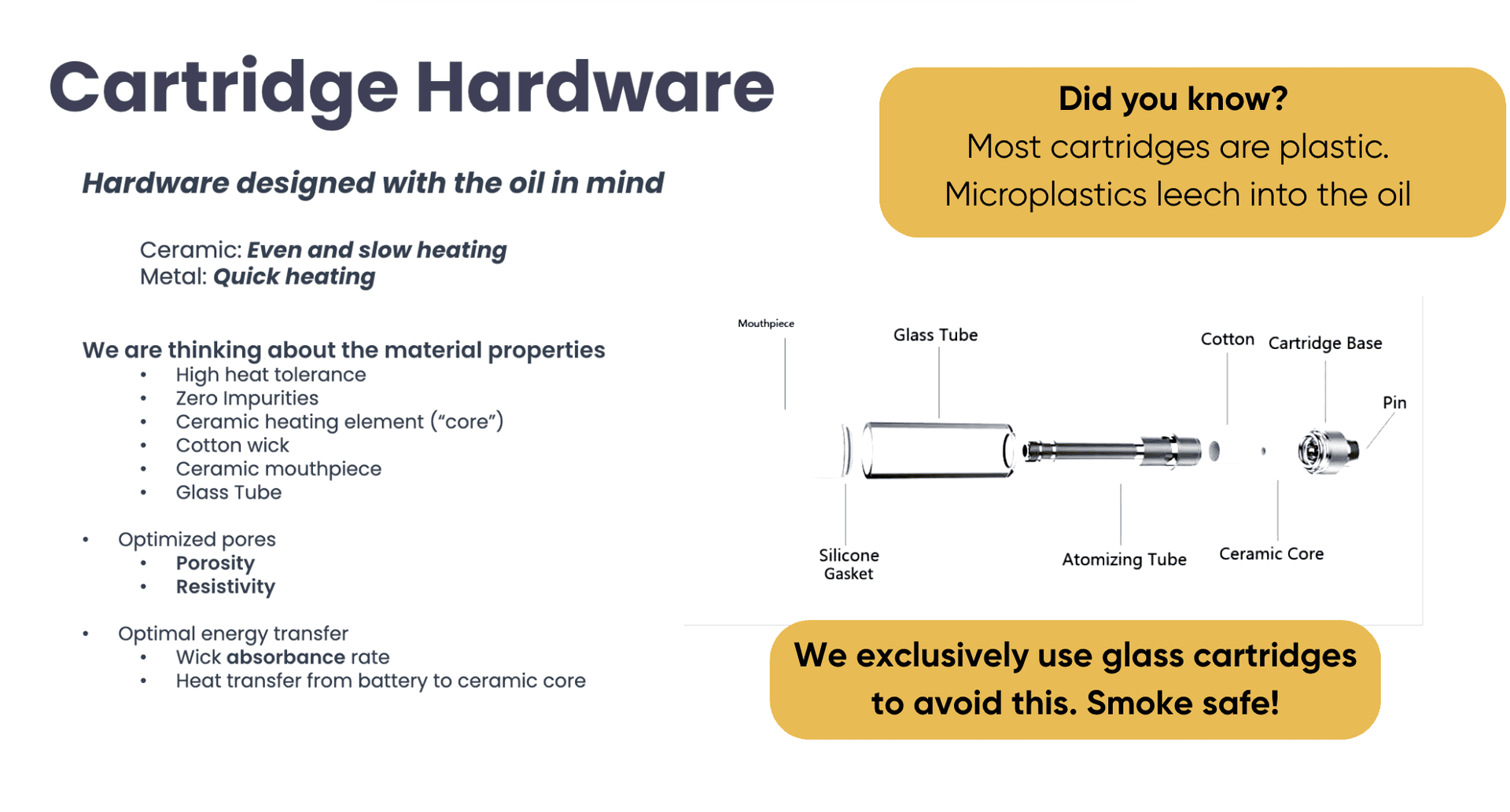
- A ceramic heating element rather than a cotton wick. Cotton chars, and every charred hit draws oil a little slower than the last one until the cart stops keeping up with you.
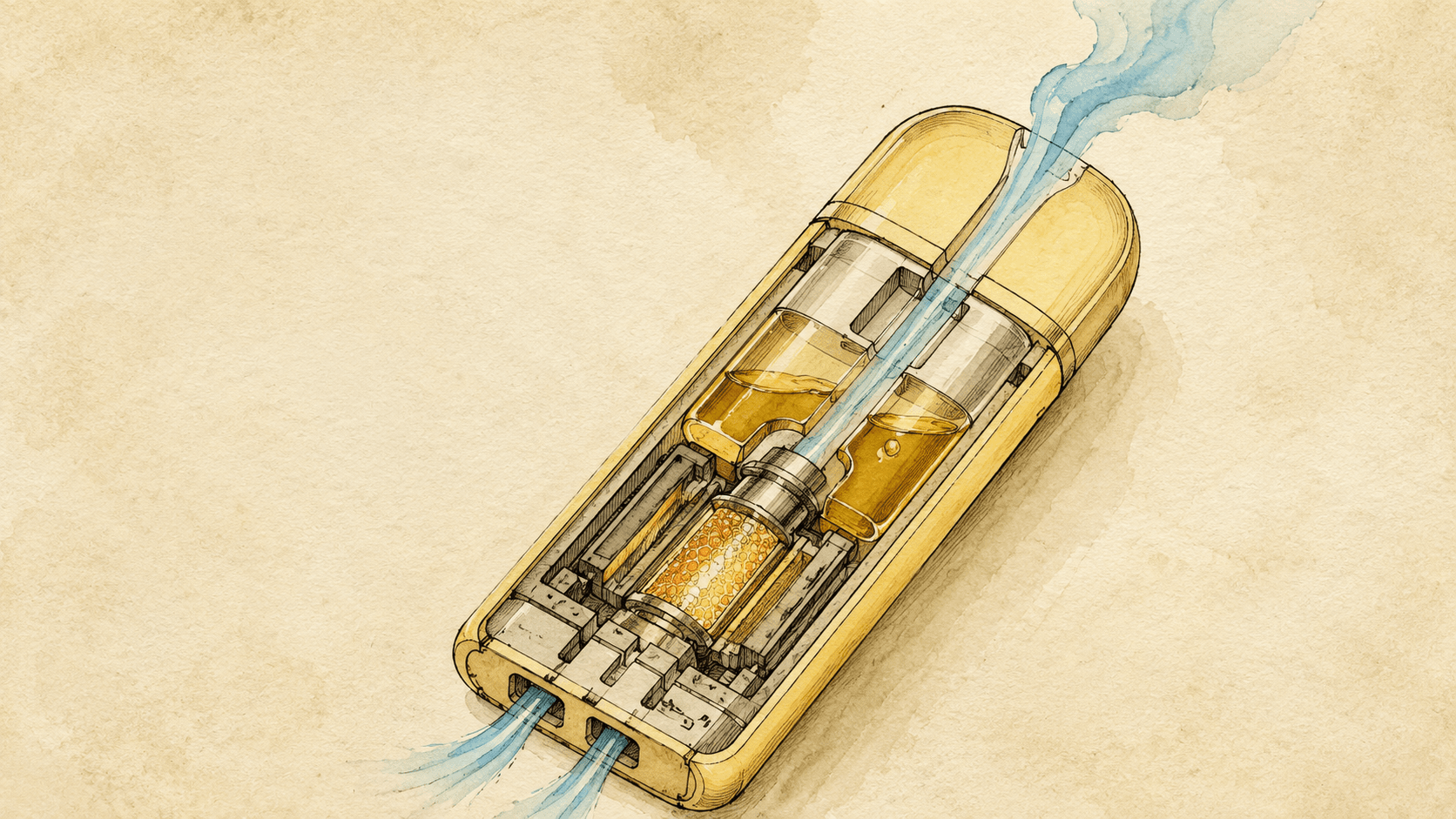
- More than one intake port. A single intake creates a hard directional pull that drags oil toward the airflow path, where it condenses on the channel walls and migrates down to the mouthpiece.
- An airflow channel without dead pockets. Every abrupt angle or diameter change is a place vapor cools and turns back into liquid.
- No adhesive anywhere in the oil path. Adhesive softens under heat and can end up in the channel as a literal physical blockage. Press-fit assembly avoids the failure entirely.
- A potency target that respects the hardware. Potency and thickness rise together, so a brand pushing the number up without re-specifying the cartridge underneath it is quietly making the clog problem worse for a better shelf tag.
You can see numbers 2 and 3 with your own eyes at the counter. The rest you have to take on disclosure, which brings us to the actual point of this post.
What California Brands Actually Disclose
Here is the method, so you can repeat it. On August 17, 2026, I read the public product pages on each brand's own website and recorded what they say about cartridge hardware. Not dispensary listings, not affiliate review blogs, not third-party numbers I can't trace. The brand's own words about its own hardware.
I'm not ranking these. I have no basis to rank them, because none of us publish a clog rate, and a ranking built out of marketing copy would be exactly the kind of list this post exists to complain about.
| Brand | What they disclose about hardware | Verifiable? |
|---|---|---|
| Jetty | Names the actual hardware: CCELL Mini Tank with EVOMax ceramic heating, on the solventless all-in-one. | Yes, on their own product pages |
| Heavy Hitters | Says its carts are "built to avoid clogging, leaking, and burnt hits" and uses "custom hardware that complements our oil." No material, no geometry, no supplier. | Claim yes, mechanism no |
| STIIIZY | Nothing about hardware on the product pages. The pod is a closed proprietary format, so you also can't inspect or swap it. | No |
| Raw Garden | Their site blocked an automated read, so I could not verify their own hardware language directly. Their oil is a high-terpene refined live resin, which is thin, and thin oil tends toward flooding rather than blockage. | Not verified |
| Select | Site certificate had expired at time of checking, so nothing verified from the source. | Not verified |
| Halara (us) | Dual intake ports, ceramic atomizer spec'd for porosity tolerance, glass tank, press-fit assembly with no adhesive in the oil path, oil formulated to a viscosity range matched to that specific atomizer. | Yes, and detailed here |
Two honest notes on that table. Jetty naming CCELL is a point in their favor and not a knock, because saying which hardware you use is a harder thing to do than saying your carts are great. And two of the six I simply could not check, which I'd rather tell you than quietly drop them from the list to make the table look cleaner.
Where This Method Falls Short
Disclosure is a proxy, not proof. A brand could describe its hardware beautifully and still ship a bad batch, and a brand that says nothing could be running excellent cartridges and just have a marketing team that writes about flavor instead.
The thing I actually want to exist doesn't: a clog rate that brands report the way they report potency, measured the same way, printed somewhere you can find it. Ours sits under 0.1% on returns, and I'll say that number out loud, but it's our own internal figure from our own returns process and you have no way to audit it. That's a real limitation of this piece and of every piece like it.
There's also plenty a cartridge can't protect you from. Leave any cart in a cold car overnight and the oil thickens past what the atomizer was designed to pull. Store one upside down for a week and gravity moves oil into the airflow channel no matter whose hardware it is. Lose the cap and lint finds the mouthpiece. Our own honest list of ways our carts can still clog is in the original post and I'd rather you read it than assume we've beaten physics.
What We Do, and What We Don't Claim
Our high-THC all-in-ones run 90 to 94% TAC depending on the batch and sit at $25 to $29 across more than 300 California dispensaries, which is above the cheap end of the shelf and below the premium live resin tier. The hardware is the reason for both halves of that. Dual airflow, ceramic, glass, and press-fit assembly cost more per unit than the standard build, and we don't get that margin back.
What I won't tell you is that ours never clog. They do, rarely, mostly to people who left one in a hot car for a month. The claim I'll stand behind is narrower and more useful: the hardware was picked against the oil rather than out of a catalog, and I can describe exactly what's in it, which is a thing most of the shelf can't do.
What To Do at the Counter
- Look at the base of the cart. Count the intake holes. Two is better than one, and it takes three seconds.
- Ask the budtender what the atomizer is. If the brand uses ceramic, they almost always say so. Silence usually means cotton.
- Ask what they know about the hardware, not the strain. A brand with a real answer has usually put it on their own website, and a budtender who's been trained on it will know.
- Treat "premium" and "clean" as noise. If specifics are available, brands use them. Adjectives are what's left when there aren't any.
- Buy the size you'll actually finish. Most clogs happen to carts that sat around, so a gram you finish in three weeks beats two grams you nurse for three months.
The industry made clogging normal by pricing it in and letting you absorb it, and it stayed normal because nobody had to answer for it. The fastest way that changes is people at the counter asking what the hardware is until brands find it embarrassing not to know.
Frequently Asked Questions
Which vape carts don't clog in California?
No brand publishes a clog rate, including us, so anyone handing you a ranked list is guessing. What you can check is what the brand discloses about its hardware. Of the six California brands I looked at in August 2026, only Jetty named its actual hardware in public (CCELL Mini Tank with EVOMax ceramic heating). Heavy Hitters claims its carts are built to avoid clogging without saying how. STIIIZY's product pages say nothing about hardware at all. Disclosure is not proof, but a brand that can describe its own hardware has usually thought about it.
What actually causes a vape cart to clog?
Thick oil that the atomizer can't pull fast enough, vapor condensing back into liquid inside a badly shaped airflow channel, and oil migrating into that channel while the cart sits in a pocket or a drawer. All three get worse when the oil is thicker than the hardware was designed for. That mismatch, not the oil quality and not the price, is the most common cause.
Does a more expensive cart clog less?
Price is a weak signal, not a guarantee. Anti-clog engineering costs real money per unit, so a $15 cart is almost certainly running the cheapest available build. But plenty of $50 carts pair excellent oil with off-the-shelf hardware nobody matched to it. Price tells you a brand could have spent the money. It doesn't tell you they did.
Do ceramic carts clog less than cotton wick carts?
Usually, though not for the reason most people think. Cotton chars, and charred cotton draws oil more slowly with every hit, which starts the chain that ends in a clog. Ceramic doesn't have that failure mode. But a cheap ceramic core with uneven porosity can char oil in one spot and pool it in another, so ceramic on the label isn't the whole answer either.
Does high THC make a cart more likely to clog?
Yes, and this is the part the industry doesn't advertise. Potency and viscosity move together, so the more potent the oil, the thicker it is and the harder the atomizer has to work to move it. A brand chasing a bigger number on the box without re-specifying the hardware underneath it is trading the product's most basic function for a shelf-tag figure.
How do I stop my cart from clogging?
Store it upright at room temperature, keep the cap on, and warm a cold cart in your hand for a minute before the first pull instead of pulling harder. Hard pulls on cold oil flood the atomizer, which is the fastest way to turn a working cart into a blocked one. None of this rescues hardware that was mismatched to the oil at the factory.
Which carts don't clog or burn out halfway through?
Clogging halfway and burning out halfway are two different failures with one shared cause, which is an atomizer that can't keep up with the oil above it. When the oil moves too slowly the element runs dry and chars, and charred residue then draws even less oil per hit. Look for a ceramic element rather than cotton, two intake ports rather than one, and a brand that will tell you which hardware it uses. A cart that made it to the halfway mark clean usually had the hardware chosen against that specific oil.
What hardware works best for thick live resin oil?
Wider intake holes and a ceramic element with even porosity. Live resin and rosin are considerably thicker than distillate, so a cartridge spec'd for thin oil will starve the element and clog. CCELL, which supplies much of the California shelf, publishes intake holes in five diameters from 1.2mm to 2.0mm precisely because the correct one depends on your oil, with the widest sizes intended for the thickest material. There is no universally correct cartridge, only one correct for a given oil.
Sources
- CCELL, What Is an Inlet Hole on a CCELL Cartridge? (manufacturer documentation on intake diameters and oil viscosity)
- US Patent Application 2024/0041109, "Vaping Cartridge" (ceramic center post lumen sizing as clog mitigation)
- Brand hardware disclosures read directly from each company's own public product pages, August 17, 2026
Malcolm
For the physics of what's happening inside a clogged cartridge, start with why vape cartridges clog. For the related but separate question of harshness, what makes a vape cart smooth covers voltage and temperature.
Want more cannabis intel?
Join The Dealers Diary — weekly strain spotlights, industry news, and insider access.
Subscribe Free