Best Distillate Carts in California (2026)
What is the best distillate cart in California?
By sales it's STIIIZY, which holds all ten top-selling vapor pen spots. Sales measure price and distribution, not quality. If you already own their battery, fine, but the pods lock you in and the brand has two DCC recalls. If you want potency with a long track record and will pay for it, Heavy Hitters. If you miss flavor, Kurvana's full-spectrum line gets closest. We make one too, with mostly botanical terpenes. Ask if it's CDT or BDT and check the recall portal.
Pull up Headset's ranking of the best-selling vapor pens in California. As of June 2026, all ten are STIIIZY pods, between $16.96 and $18.00, and every single one is distillate.
Look closer at the names and something else shows up. Skywalker OG CDT Distillate. Blue Burst BDT Distillate. Pineapple Express Botanically Derived Terpenes Distillate. The biggest brand in the state is printing its terpene sourcing directly into the product name on the menu, on the top ten best-sellers, and my honest guess is that most people buying them have never been told what those letters mean.
That's what this post is about, because it's the thing that actually separates one distillate cart from another, and nobody selling you one is in a hurry to explain it.
I Make These, So Weigh It Accordingly
I run the extraction side at Halara. We make distillate all-in-ones and 510 cartridges and sell them in roughly 300 California stores, so I have a direct interest in you liking ours.
I'm also not going to pretend distillate is something it isn't. It's the cheap-to-make, high-potency lane, and it's the lane California keeps pulling off shelves. Both of those are true at the same time and you should hear them from someone who makes the stuff.
Distillate Is Still Most of the Market, and Slipping
BDSA has distillate at about 55% of vape dollars as of May 2026, down from roughly 59% on a trailing basis. Absolute dollars are close to flat, so distillate isn't shrinking so much as everything else is growing around it. Live resin hit 28% in May, up from 26% across the trailing year.
California is its own case. Vape passed flower here and holds 31% of retail against flower's 30%, and cartridges still take 54% of vape dollars, which is backwards from the rest of the country where disposables crossed 50% in April. We wrote about why that happened, and the short version is that California caps a concentrate at 1,000mg of THC per package, which a 2-gram cart at full potency can't clear, so the cheap version of that format never arrived.
What the share numbers mean practically: distillate is what's on most of the shelf, at the bottom of most price ranges, and it is losing ground to oils that cost more. So the interesting question isn't whether to buy distillate. It's how to buy a good one.
What CDT and BDT Mean on a Vape Cart
CDT stands for cannabis-derived terpenes and BDT stands for botanically derived terpenes. Distillation strips nearly everything out of cannabis oil except THC, including the terpenes that give it flavor and smell, so flavor has to be reintroduced afterward. CDT means those terpenes came back from cannabis. BDT means they came from other plants, or from synthesized equivalents.
This is not a scandal and it isn't a loophole. It's the defining fact of the category. A distillate cart tastes like something because someone chose what it should taste like, which is why a Blue Dream distillate pod from two different companies can taste nothing alike while a Blue Dream rosin from those same two companies will taste roughly the same.
The tradeoffs run in both directions. Botanical terpenes are cheaper, far more consistent from batch to batch, and let a brand hit a flavor target every single time. Cannabis-derived terpenes cost more, vary with the harvest, and taste closer to what the plant actually did. Some people find botanicals read as slightly sharp or candied. Plenty of others prefer them, and the sales data says the market is not exactly voting against BDT.
What I'd push back on is a brand that doesn't tell you. STIIIZY puts it in the product name, which whatever else you think of them is more disclosure than most of the shelf offers. If a cart's marketing talks about a strain's flavor profile at length and never says where the terpenes came from, you have learned something.
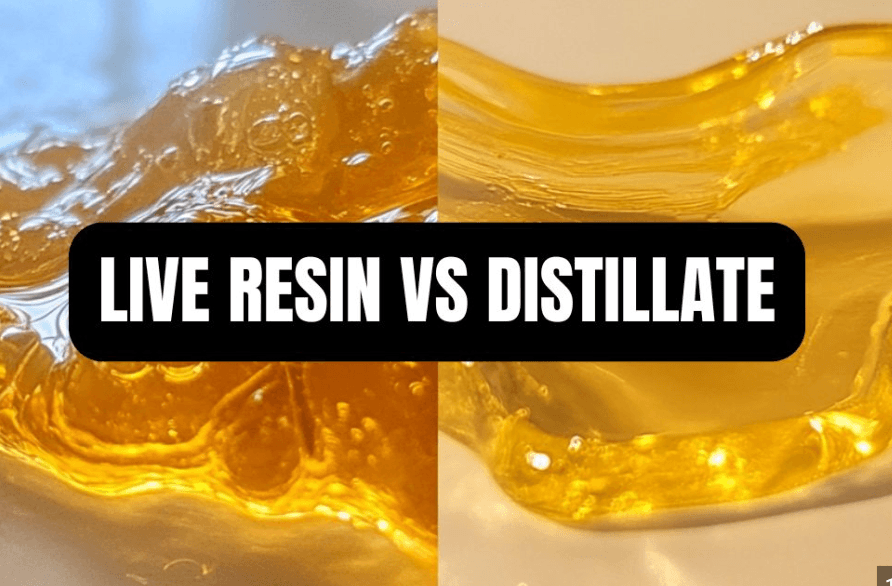
If you want the version where the terpenes were never removed in the first place, that's a different product and a different price. Live resin and live rosin keep the plant's own terpenes through the process, which is most of why they cost 50 to 100% more per gram.
Why Distillate Is the Category California Keeps Recalling
Look at the state's vape recall record and it's overwhelmingly one problem. Pesticides.
STIIIZY twice, the second on July 2, 2026, voluntary, pyrethrins in Watermelon Z, covering both the cartridge and the all-in-one. West Coast Cure four separate times for chlorfenapyr, three of them mandatory. Punch and Mr. Zips for daminozide. CRU, Flav, Cali Heights, Kind Republic, Phire, Panda Pen. Backpackboyz and Circles ended with the manufacturer's license revoked and 194 products embargoed. Luigi in March 2026 for something more unsettling than a specific chemical, which the state described as distillate from an unknown and unidentifiable source.
The explanation everyone in this industry gives is that extraction concentrates whatever was on the plant, so a pesticide level that passes on flower can fail once you've refined that flower down into oil. I believe that's right, and it's why a real pesticide-remediation industry exists selling chromatography equipment to people like me.
But I went looking for the study that proves it and it isn't really there. The best review I found, Dryburgh and colleagues in the British Journal of Clinical Pharmacology, says plainly that they identified no comparative analyses quantifying contaminant levels between whole and purified cannabis preparations. So the mechanism everyone repeats, including me, is an industry consensus that the literature hasn't actually measured. I'd rather tell you that than cite a study I can't produce.
What isn't in doubt is the record itself, and the record is public. California hands you every one of these notices for free, searchable by brand, which is a genuinely unusual thing for a state to do. We keep our own copy of it, us included.
What Distillate Is Actually Good At
None of the above means don't buy it. Distillate does a few things better than anything else on the shelf.
It runs 85 to 95% THC against roughly 70 to 85% for live resin, and it costs less per gram because dried flower and trim are cheaper inputs than fresh-frozen material. If what you want is potency per dollar, nothing else is close, and the top ten best-sellers in this state at seventeen dollars are that argument winning in public.
Most distillate also comes on a 510 thread, so it fits a battery you already own and like. The two biggest brands in the category, STIIIZY and PLUGPLAY, are the exceptions, both running proprietary pods that only work with their own hardware. That's worth knowing before you buy into an ecosystem.
And it's consistent. A well-made distillate cart hits the same way in March and in November, which for a lot of people is the entire point.
What Makes a Good Distillate Cart
Six things, and the THC number isn't one of them.
- A stated terpene source. CDT or BDT, printed somewhere you can find it. Not knowing means the brand decided you shouldn't care.
- A batch-specific COA, not a QR code that lands on a generic lab page. The batch number on the box should appear on the document.
- A clean record on the state recall portal. Distillate is the category California pulls most often, so this is a live question here, not a formality.
- 510 thread, unless you're deliberately buying into a pod ecosystem. Proprietary hardware means the brand owns your battery decision for as long as you keep buying.
- Hardware that empties. A cart that dies with oil in it cost you more than the pricier one you'd have finished.
- Honest potency. Anything claiming much north of 95% is either rounding hard or telling you something about its testing lab.
The Distillate Brands Worth Knowing
The obvious caveat first: I make one of these. Weigh it accordingly.
Also worth saying plainly, because most "best carts" lists blur it: Raw Garden and Jeeter are not distillate. They're live resin and liquid diamonds respectively, which is a different oil at a different price. Buyers cross-shop them against distillate constantly, so they're in the frame, but they don't belong on this list.
STIIIZY
The biggest vape brand in the country and first in California two years running, taking roughly a fifth of every vape dollar in the state. Pods run $17 to $18 and hold all ten of the state's best-selling vapor pen slots. Distillate sits around 80 to 90% THC, and to their credit they print the terpene source directly in the product name, CDT or BDT depending on the SKU, which is more disclosure than most of this shelf offers.
The catch: proprietary pods that only fit their own battery, and two DCC recalls. Premium THC Pods in December 2024 for Category I pesticides, and a voluntary one on July 2, 2026 for pyrethrins in Watermelon Z, covering the cartridge and the integrated vaporizer both.
Heavy Hitters
Doing California distillate longer than almost anyone, and one of the few brands that prints a potency figure right on the Ultra Extract line. 510 thread, CCELL ceramic hardware, distillate testing in the 90 to 95% range. Prices sit well above the roughly $18 the state averages, so you're paying for the potency and the track record.
The catch: the price. No recall found on the DCC portal, records reviewed July 27, 2026.
PLUGPLAY
California-born, tenth nationally, and a genuinely different product shape: magnetic pods rather than 510. Distillate runs 80 to 90%, with a DNA line and an Exotic line at different price points. Really competing with STIIIZY's pods more than with anything else here.
The catch: the magnetic pods only fit the PLAY battery, so it's the same ecosystem lock-in as STIIIZY with a smaller store count behind it. No recall found on the DCC portal, records reviewed July 27, 2026.
Kurvana
The premium end. The ASCND line is full-spectrum rather than stripped-and-rebuilt distillate, strain-specific, 510 thread. If flavor complexity is what you're missing from distillate, this is the closest thing in the category to fixing it without leaving it.
The catch: premium pricing, and "full-spectrum" moves it partway toward live resin, so you're not really buying distillate's value argument anymore. No recall found on the DCC portal, records reviewed July 27, 2026.
AbsoluteXtracts (ABX)
Homegrown California, supercritical CO2 extraction, strain-specific carts in the mid $30s to low $40s. Listed here because buyers shop it against distillate, with the honest asterisk that CO2 full-spectrum is a different process than distillation.
The catch: it isn't distillate, strictly, and you're paying a premium over the category. No recall found on the DCC portal, records reviewed July 27, 2026.
Halara (that's us)
Distillate at around 90% THC, in a rechargeable USB-C all-in-one with dual airflow and hardware built specifically against clogging, plus a 510 cartridge if you already own a battery. Near $29 on most menus, discounted below that fairly often. Strains people actually ask for: Blue Dream, Guava Gelato, Pineapple Express. Every batch carries a batch-specific COA behind a QR code.
Since I spent half this post telling you to ask: ours are mostly botanical. A few strains have cannabis-derived terpenes blended in, but if you pick one of ours off the shelf at random, the flavor came from a plant that wasn't cannabis. I'd rather tell you that than let the question sit there after I made it the whole point.
The catch: distribution. STIIIZY is in vastly more doors than we are. If you want to walk into any store in California and find the thing, that's a real advantage and I'm not going to argue otherwise. No recall on the DCC record, as of July 27, 2026.
Two strain-level notes, since they came up while writing this. Granddaddy Purple is the one classic where you can actually name the breeder, and it has real competition in California, which most strains don't. Guava Gelato is the opposite: barely anyone licensed makes it, and most of what turns up when you search for it is being sold outside the legal system entirely.
What I'd Check Before Buying
- Search the brand at recalls.cannabis.ca.gov. It takes ten seconds and California is one of the only places that gives you this.
- Find out whether the terpenes are CDT or BDT. If the brand won't say, assume botanical.
- Open the COA and check it's tied to the batch in your hand, not just a QR code that resolves to a generic page.
- Stop weighing the THC percentage once a few options clear 80%. Refining is what pushes that number, so in this category especially it measures process, not experience.
- Check whether it's 510 or proprietary, because that decision follows you.
Frequently Asked Questions
What is the best distillate cart in California?
By sales, it isn't close. Every one of the ten best-selling vapor pens in California as of June 2026 is a STIIIZY distillate pod, priced between $16.96 and $18.00. That tells you what wins on distribution and price, not what wins on quality. What separates a good distillate cart from a bad one is whether the terpenes are cannabis-derived or botanical, whether the COA is tied to your actual batch, and whether the brand shows up on the state recall portal. None of that is the THC number.
What does CDT and BDT mean on a vape cart?
CDT is cannabis-derived terpenes and BDT is botanically derived terpenes. Distillation strips almost everything out of the oil except THC, so flavor has to be put back in afterward. CDT means the terpenes came from cannabis. BDT means they came from other plants, usually citrus peel, pine, or lab-synthesized equivalents. Neither is dishonest and both are legal in California. BDT is cheaper and more consistent batch to batch, CDT tastes closer to the plant.
Is distillate worse than live resin?
It's different, not worse. Distillate runs 85 to 95% THC against roughly 70 to 85% for live resin, and costs meaningfully less per gram because it's made from dried flower and trim rather than fresh-frozen material. What you give up is native flavor, since the terpenes in a distillate cart were reintroduced rather than preserved. If you're buying potency per dollar, distillate wins the math. If you're buying how the plant actually tasted, it doesn't.
Which California distillate brands have been recalled?
The Department of Cannabis Control publishes every one at recalls.cannabis.ca.gov. On the vape side that includes STIIIZY twice, most recently July 2, 2026 for pyrethrins in Watermelon Z. West Coast Cure four times for chlorfenapyr, three of those mandatory. Backpackboyz and Circles, mandatory, manufacturing license revoked. Also Punch and Mr. Zips for daminozide, plus CRU, Flav, Cali Heights, Flavorz, Ape Vape, Zurpz, Luigi, Nfuzed, Canna America. Almost all of them are pesticides.
Does a higher THC percentage mean a better distillate cart?
No, and distillate is where this matters most, because refining the oil is exactly what pushes the number up. A 2020 JAMA Psychiatry study compared people using roughly 16% THC flower against people using concentrates over 70%. Blood THC came out wildly different. Self-reported high, balance, and cognitive impairment came out about the same. Once a few options clear 80%, the number has stopped telling you anything useful.
Where can I buy Halara distillate carts in California?
About 300 dispensaries across the state carry our High THC line, in both a rechargeable all-in-one and a 510 cartridge, running around 90% THC. Our terpenes are mostly botanical, with cannabis-derived blended in on a few strains. You can find the closest one on our store locator at halaracannabis.com/find.
Sources
- California DCC Recall Portal: every cannabis recall in the state, searchable by brand
- Headset, best-selling California vapor pens: the June 2026 top-ten ranking and prices
- BDSA cannabis vape trends: distillate and live resin share of vape dollars, disposable versus cartridge split
- Dryburgh et al., British Journal of Clinical Pharmacology, 2018: cannabis contaminants review, including the gap in comparative data on concentrates
- Bidwell et al., JAMA Psychiatry, 2020: concentrate potency versus actual intoxication and impairment
Recall status reflects DCC records reviewed July 27, 2026. "No recall found" means what it says and isn't a permanent guarantee. Market share figures from BDSA (May 2026) and Headset (June 2026). Check any brand yourself before you buy.
Related Strains
Want more cannabis intel?
Join The Dealers Diary — weekly strain spotlights, industry news, and insider access.
Subscribe Free