Pride and Pot: How the Castro's AIDS Crisis Built California's Cannabis Industry
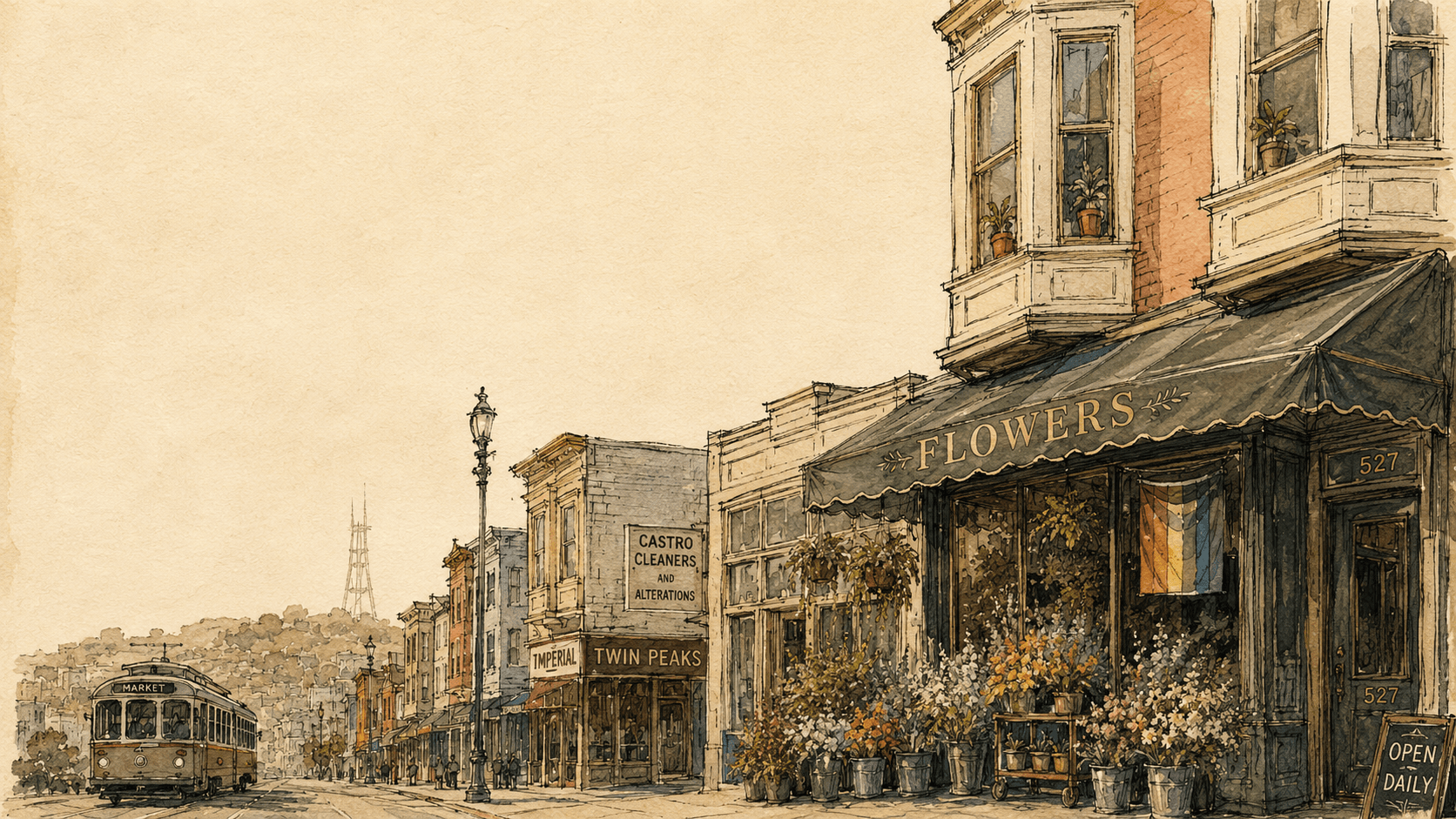
The Back Room of a Flower Shop on Castro Street
If you walked into a particular flower shop on Castro Street in 1992, you might have been handed a paper bag of cannabis with your receipt. The man behind the counter was named Dennis Peron. The bag was technically illegal under California law and the law that existed federally, and would remain so for another four years. The people he was selling it to were mostly dying.
That back room is where California's legal cannabis industry actually started. Not in a boardroom, not in a dispensary in 2018, not in a venture-capital deck. In a flower shop in the Castro, in the worst years of the AIDS crisis, run by a gay activist who watched his partner die of AIDS-related complications and started giving cannabis to other patients because it was the only thing that helped them eat. Every California cannabis brand on a dispensary shelf today, including ours, exists because of what happened in that room.
June is Pride. It's also the month we're releasing a strain that we ended up calling LGBT, partly because the acronym wrote itself, but mostly because the history is worth saying out loud.
Why California Cannabis Owes Pride a Debt
Most people who know anything about California cannabis know about Proposition 215. It was the 1996 ballot measure that legalized medical cannabis in California, the first state to do so, and the one that set off the slow-motion legalization wave that eventually produced what's now a multi-billion-dollar national industry.
What most people don't know is what Prop 215 actually was, in the room, in the moment. It wasn't a generic medical-marijuana bill written by policy wonks. It was an AIDS activism document, drafted by people who had spent the previous decade watching their community get sick and die while the government did almost nothing. Cannabis helped AIDS patients with nausea, with the wasting syndrome that came with late-stage HIV, with the appetite collapse that made antiretrovirals impossible to keep down. The medical evidence was thin in 1996. The lived evidence, in the Castro, was undeniable.
The same political networks that had organized ACT UP, that had marched on City Hall, that had buried hundreds of friends, were the ones that gathered the signatures. The activism muscle that built the legal cannabis industry in this state was queer activism muscle. Some of it grieving, some of it furious, all of it experienced at fighting institutions that weren't going to move on their own.
Dennis Peron and the Cannabis Buyers Club
Dennis Peron is the name on the paperwork, but he's worth knowing as a person.
Peron moved to San Francisco in the early 1970s and got involved in gay activism almost immediately. By the mid-1980s he was running an illegal cannabis-distribution operation out of his apartment, then out of a series of storefronts, supplying mostly AIDS patients in the Castro. He was raided multiple times. His partner Jonathan West, who used cannabis to manage AIDS symptoms, died in 1990. Peron wrote Prop 215 partially in his memory and partially because he was tired of his customers dying with police reports filed against them.
In 1992 he opened the San Francisco Cannabis Buyers Club at 1444 Market Street, the first public, member-based cannabis dispensary in the United States. Members had to show medical documentation. Most of them were AIDS patients. The operation was illegal at every level of government, and it ran in the open, in a city that had decided collectively to let it run. The mayor knew. The DA knew. The patients knew where to go.
What that club proved is that you could distribute cannabis to sick people in a structured, documented, community-accountable way without society falling apart. That proof is what made Prop 215 possible. The campaign for the ballot measure wasn't a hypothetical argument. It pointed at a building on Market Street and said, that. We want that, legal, statewide, for people who need it.
Prop 215 Wasn't the First Step. It Was the Last One.
This is the part the standard history tends to skip.
By the time California voters passed Prop 215 with 55.6% of the vote in November 1996, the underground patient-centered cannabis economy in San Francisco had been running for almost a decade. The buyers club model had been replicated quietly in Oakland and Berkeley. Patients knew where to go. Doctors who couldn't legally write a prescription could legally write a recommendation note, and a network had developed to honor those notes. The legal framework that Prop 215 created was, in large part, a description of what was already happening, codified.
That matters because it tells you something about what legal cannabis in this state was supposed to be. It wasn't supposed to be a recreational consumer category, a luxury product, or an investor asset. It was supposed to be a patient-care infrastructure that the state had agreed not to prosecute. The recreational legalization that came with Prop 64 in 2016 grafted a consumer market onto that infrastructure, and the consumer market is now what most of the industry actually does. But the bones underneath are still the bones that Dennis Peron and a generation of AIDS activists built.
What That 1996 Activism Left to California Cannabis Today
You can see the inheritance in places people don't look for it.
The compulsory lab testing on every California cannabis product, the requirement for a Certificate of Analysis on every batch, the careful track-and-trace system that follows a plant from seed to sale. None of that came from recreational consumers asking for it. It came from a patient-care model where the people consuming the product literally could not afford a contaminated batch. AIDS patients on antiretrovirals can't tolerate pesticide residue. Cancer patients on chemo can't tolerate aspergillus. The lab discipline that California cannabis is held to is a direct inheritance from a population that needed it to survive.
The same is true of the dispensary model itself. The fact that you walk into a place with a counter, a budtender, and a community ethos rather than a vending machine. The fact that anyone working a dispensary counter in California for any length of time tends to acquire a real grandmother's-pharmacy knowledge of strains and effects and dosing. That's not a retail invention. That's the inheritance of buyers-club staff who were trained, in the 1990s, to figure out which strain helped a wasting AIDS patient hold down a meal.
If you've ever wondered why California cannabis culture is so granular about terpenes and effects compared to other consumer categories, that's where that granularity comes from. It came from a community that needed to be precise because the stakes were not theoretical.
The Numbers That Say Pride Still Hasn't Been Repaid
Here's the part that gets uncomfortable to write.
Roughly 1 in 5 cannabis consumers identifies as LGBTQ+, well above the percentage in the general population. The community that built the political infrastructure for legal cannabis is the same community that still over-indexes as cannabis consumers. And yet, by most estimates, fewer than 5% of licensed cannabis businesses in the United States are LGBTQ-owned. The community that opened the door isn't, by and large, the community standing inside the room.
That gap is the unfinished business of California cannabis. It's also the reason most of what the industry does for Pride feels slightly off. A rainbow logo on a package in June, then back to the regular logo in July. A "we support the community" line in a press release. A donation that turns out to be a percentage of a percentage. The history is grand enough that the gestures look small by comparison.
That's not to say the gestures don't matter. Money to community organizations matters. Visibility matters. Hiring matters. But the size of the debt is bigger than what most of the industry, ours included, is yet doing about it.
What We're Doing in June (And Why It's the Least)
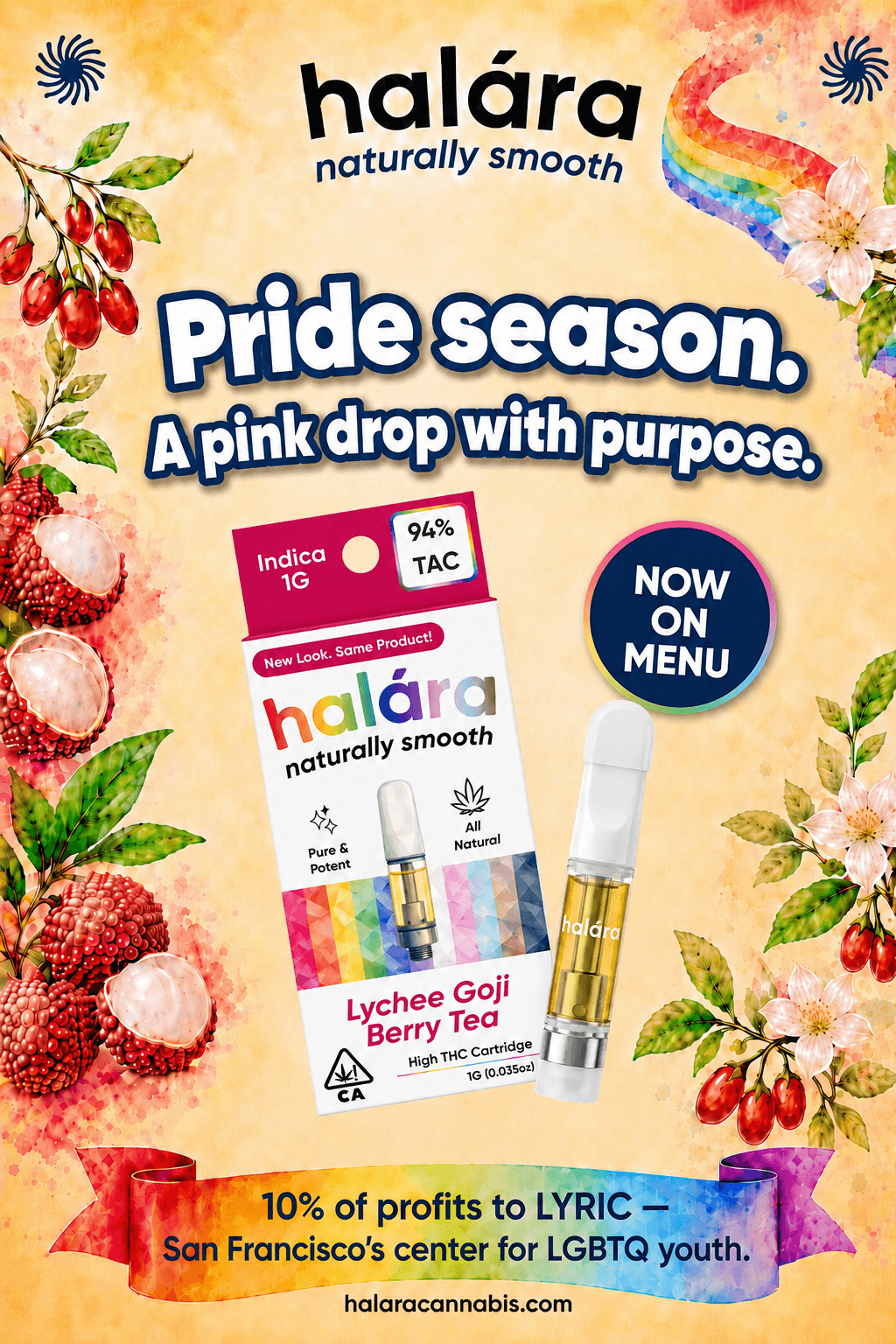
Our June release is a hybrid distillate cart we ended up calling LGBT. The acronym wasn't planned. The strain is Lychee Goji Berry Tea, named for the flavor profile, and the abbreviation just happened. We laughed about it for a day, then looked at each other and realized it wasn't an accident, it was a sign. So we're leaning in.
Lychee Goji Berry Tea is a 92% THC hybrid with a Limonene-led terpene profile, lychee and goji on the front, jasmine tea on the finish. It lands uplifted and relaxed in roughly equal measure, which fit the spirit of the release. 10% of profits from the June run go to LYRIC Center for LGBTQ+ Youth in San Francisco, the organization that supports the next generation of queer kids in the same city Dennis Peron worked out of.
That's the least we can do, not the most. We're not pretending otherwise. The industry exists because of community organizing in the Castro. Sending some of the proceeds back to a youth center six blocks from where the Cannabis Buyers Club was is the smallest gesture that makes sense, not the biggest. We'll keep working on doing more.
Where the Industry Still Falls Short
I want to be honest about the things this post is not.
This post is not an argument that buying a Pride-themed cannabis product is activism. It isn't. It's a purchase, and the donation that goes with it is small. Activism is what Dennis Peron and ACT UP and the buyers clubs did, and what the LGBTQ+ organizers and queer-owned cannabis brands across California are still doing today. Buying a cart isn't the same thing.
This post is also not an argument that the cannabis industry has been a good steward of the community that built it. It hasn't, not yet. The ownership numbers tell that story plainly. The cultural memory of why this industry exists is thin in most of the boardrooms where decisions get made.
And this post is not a one-time June post. The history we're trying to point at didn't happen in June. It happened across two decades, mostly in pain, and the work of honoring it is a year-round job, not a marketing window. We'll try to remember that in October, in February, in months that don't come with a flag.
The Closing
The reason any of us are selling cannabis legally in California is that a community refused to die quietly. They organized. They built distribution networks. They drafted ballot measures. They survived an epidemic that the rest of the country tried not to see, and they built, in the middle of it, the political infrastructure that became an industry.
The least the industry can do is remember.
If you want to read more on the queer cannabis lineage, Rolling Stone has a deeper feature that's worth your time. And if you're in San Francisco and want to get involved with the youth org that the LGBT release is supporting, LYRIC is at 127 Collingwood Street in the Castro.
Related Strains
Want more cannabis intel?
Join The Dealers Diary — weekly strain spotlights, industry news, and insider access.
Subscribe Free